

The market for punters who are sure who wins but unsure by how much
I once placed a £20 match-winner bet on a heavy favourite and watched it return a pound after the dust settled. The same favourite, the same match, the same prediction — but the winning margin bet on “13–24 points” would have paid £80. That gap, between the match-winner price and the margin price, is the entire reason winning margin betting exists. You are charging extra for knowing not just who wins, but by how much.

Winning margin betting is a band-based market. Instead of a single number you have to beat — the way a handicap line works — you back a specific range. The favourite wins by 1–12 points, by 13–24, by 25 or more. Each band carries its own price. The price grows the further the band sits from the most likely scoreline, and shrinks as the band approaches it. You pick the band you believe the final scoreline will sit inside.
The closely related market is the handicap. The two are easy to confuse, and they reward different kinds of analysis. The handicap is a single line and a binary call. The margin market is a set of bands and a more precise call. Both bet on “by how much”, but they are not the same product.
Margin bands explained
The standard UK winning margin market is split into several bands per team plus a tie. A typical structure for a Rugby World Cup match might look like: Team A by 1-12, Team A by 13-24, Team A by 25+, Team B by 1-12, Team B by 13-24, Team B by 25+, and draw. Some books offer narrower bands (1-5, 6-10, 11-15, etc.) and some go wider (1-15, 16-30, 31+). The bands are operator-specific, so two books can have noticeably different shapes on the same fixture.

Each band carries a separate price. The most likely band on a heavy mismatch — say, favourite winning by 13-24 — typically prices around 3.50 to 4.50. The next most likely band sits around 4.50 to 6.00. The long-tail bands stretch into 12.00 to 25.00 territory. Underdog winning margin bands almost always sit at 10.00 or higher on mismatch fixtures, and the draw price can reach 60.00 or more on lopsided matches.
The total margin market is essentially a probability distribution dressed up as a betting menu. The book has estimated the chance of each band landing, applied its overround, and published the prices. A punter who agrees with the book’s distribution will find very little value in the bands. A punter who disagrees with the distribution in one specific band has the bet.
Some books also offer combined markets — winning margin together with handicap, or winning margin together with first-half result. These are essentially bet builders by another name. They pay more, they cash less, and the maths is the same as on any compound bet. Treat them with the same caution as any acca-style slip.
The most reliable margin bands historically have been the “middle” bands on heavy favourites — the 13-24 and 16-30 ranges depending on operator. New Zealand and South Africa have won 7 of the last 10 Rugby World Cup tournaments between them, and the margins by which they win pool matches against tier-two opposition cluster heavily in the 20-40 range. The “obvious” band is often the right band, but the price has compressed to match.
How margin differs from handicap
The handicap market is a single line with two outcomes. The favourite covers or does not. The margin market is a distribution with multiple outcomes, only one of which pays. That structural difference is what makes them complementary rather than redundant.
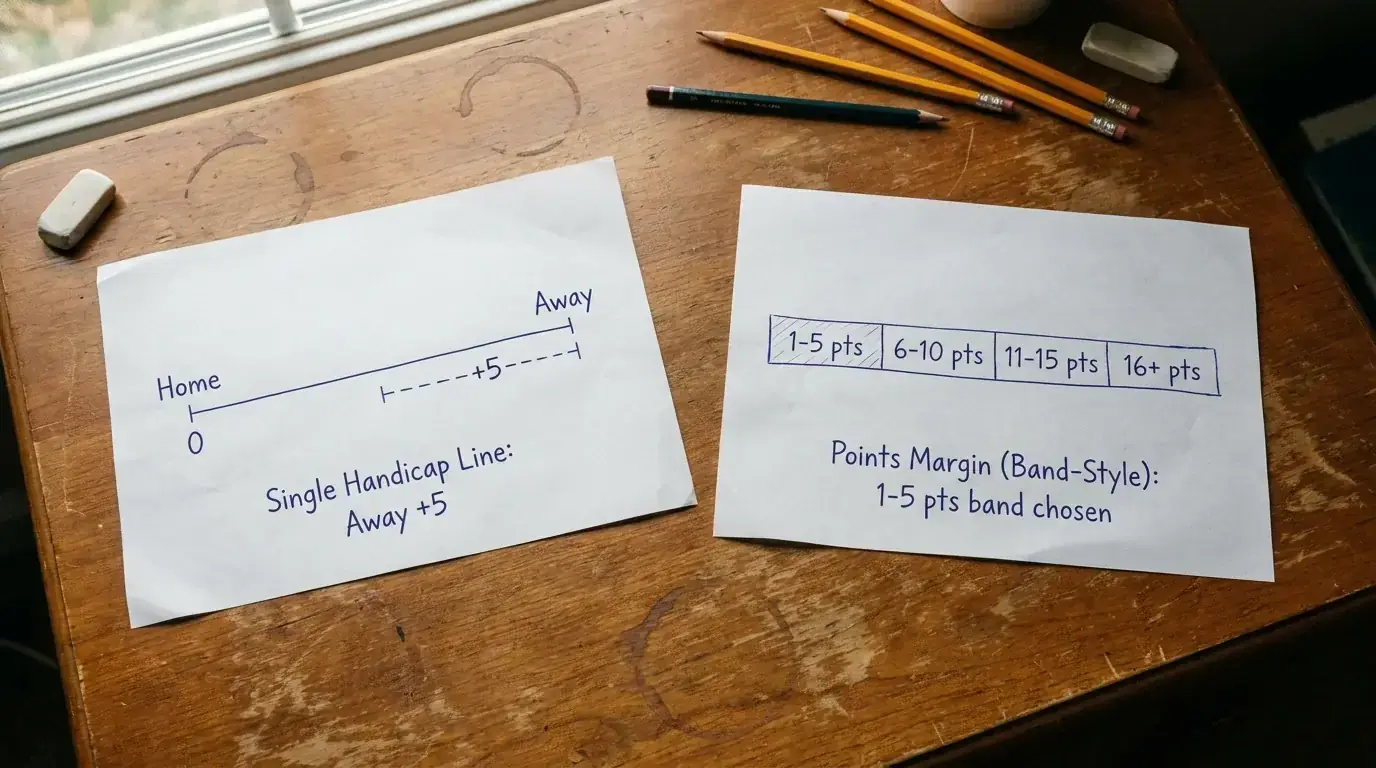
A handicap line of -15.5 implies the bookmaker thinks the favourite has a roughly 50% chance of winning by 16 or more. It does not tell you anything about whether the favourite is more likely to win by 17 or by 35. A margin bet on the 13-24 band, by contrast, says explicitly that the favourite wins by exactly 13-24 points. Both bets can be right and wrong simultaneously: if the favourite wins by 30, the handicap slip cashes and the margin slip does not.
The implication is that the two bets reward different inputs. A handicap edge is about whether the favourite covers the line on average. A margin edge is about which specific scoreline range is most likely. The first is a coarser read and easier to get right. The second is a finer read and rewards more precise analysis.
In practice, I find the margin market most useful in two scenarios. The first is when I think the favourite will win but not blow out — a tight knockout match where the handicap line of -7.5 might be misleading because the favourite will likely cover narrowly. The “1-12” margin band captures that scenario and pays better than the corresponding handicap. The second is when I think the favourite will blow out beyond what the handicap line suggests — a pool fixture where the bookmaker has lowered the handicap to account for rotation, but I think the side will play their first-choice fifteen and dominate. The “25+” band captures the dominant scenario and pays meaningfully more than the handicap.
The market is also useful as a hedge layer. If you have an outright slip on a heavy favourite and want to lock in a profit on their first pool match, a margin bet on the band slightly above the bookmaker’s expectation does double duty — it pays out independently if the band lands and reduces variance on your overall position. The totals market sits adjacent to the margin market for the same kind of analytical work.
Spotting blowout fixtures
Blowouts at the Rugby World Cup follow patterns, and the patterns are not subtle once you start looking for them. Three factors compound to produce the kind of 40-plus margin wins that the long bands pay so well on.

Squad depth difference is the first. A tier-one side fielding their first-choice XV against a tier-two side fielding theirs is a gap of roughly 20-30 points on neutral conditions. The same first-choice XV against a tier-three side fielding theirs is closer to 50-70 points. The new 24-team format expands the field’s lower tail, which means more pool fixtures with the kind of tier gap that delivers blowouts. The “25+” margin band on those fixtures is the canonical bet, and the bookmakers are not always generous enough on the further bands.
Set-piece dominance is the second. A scrum that is winning penalties at every put-in compounds across 80 minutes. The trailing side ships territory, concedes line-outs, watches their fly-half make decisions from increasingly desperate positions, and the scoreboard widens far beyond what the open play patterns alone would suggest. A pre-match diagnostic on the relative scrum strength of the two sides is one of the cheaper inputs to a margin slip.
Pace of the match is the third. Some referees keep the ball alive and the game open. Others let the contest slow down with multiple resets and a high penalty count. Open, high-tempo matches tend to produce wider margins because the better side has more opportunities to score. Slower matches with frequent resets compress margins. Knowing the referee’s style — easily verifiable from recent appointments — sometimes shifts a margin slip from one band to the next.
One pattern I have used reliably is the second-pool-match blowout. Tier-one sides who lost or struggled in their opening pool match often respond by putting their first-choice XV against a tier-two opponent in the second match and running up a score. The margin slip on “25+” or “31+” against the second-match opponent pays well, because the book has not always priced in the response factor. This is a small edge, but it has been consistent enough to bother tracking.
The slip I take and the bands I avoid
I take the middle band on heavy mismatches when the bookmaker has been generous on it. The 13-24 or 16-30 band on a tier-one favourite against a tier-two opponent. The price is typically 3.50 to 4.50 and the actual cash rate on these slips is high enough to justify the price.

I take the wider band — 25+ or 31+ — when I have a specific structural read that points to a blowout. Squad rotation in favour of first-choice players, weak opposition forwards, a dry forecast, an attacking referee. The slip pays 4.00 to 6.00 and cashes less often than the middle band but does so often enough to be a positive expected value position when the inputs line up.
I avoid the narrow bands on tight contests. Margin betting on tight knockout matches is the betting equivalent of trying to guess the exact result. The variance is enormous, the prices look generous, and the slip cashes only on a specific shape of contest the punter cannot reliably predict. I have lost more money on “1-12” bands in knockout matches than on any other rugby market I bet.
I avoid the draw band entirely. The price is long, the cash rate is roughly 1% across all Rugby World Cup matches, and the bet is essentially a long-shot lottery wrapped in the appearance of analytical betting. There are better long shots on the menu.
