


We will deal in numbers wherever we can.
The first Rugby World Cup market I priced for myself was the 2011 outright. I had a spreadsheet, a calculator, and a strong opinion about the All Blacks at home. Seven years of full-time work on this sport later, the spreadsheet is much bigger and the opinions are much quieter — but the principle has not changed. Rugby World Cup betting rewards punters who treat it as a tournament problem with data behind it, not a sequence of impulse bets on whichever match BBC happens to be showing on a Saturday afternoon.
This is not the football World Cup, and it is not Six Nations. It is a specific market with its own rhythm: two live events on the horizon — the women's Rugby World Cup that broke records across England in 2025, and the men's tournament that lands in Australia in 2027 in a format the sport has never used before. The British betting public has been pricing these games since the late 1980s, and the surrounding industry has changed beyond recognition. The Gambling Commission now regulates a £16.8 billion market, and the way that market is supervised, taxed and disclosed dictates how every Rugby World Cup price you see in the United Kingdom is built.
What follows is the guide I would have wanted in 2011: how the odds are constructed, which markets actually trade with depth, how to read the 2027 expanded format, why the women's game is now a serious betting product, and — the part most rivals skip — how to do all of this without losing the run of yourself. We will deal in numbers wherever we can. Vibes have their place, but not in your staking plan.
The Short Version Before You Read On
- The UK regulated gambling market is worth £16.8 billion in gross gaming yield, with online up 13.1% — meaning rugby prices in Britain sit inside the largest licensed online market in the world.
- New Zealand (around 3.50) and South Africa (around 3.75) head the men's RWC 2027 outright; the two nations have won seven of the ten World Cups ever held.
- The 2027 tournament expands to 24 teams in six pools with a new Round of 16, 52 matches and over 2.5 million tickets — bigger pricing inefficiencies follow a bigger field.
- The women's Rugby World Cup 2025 sold 444,465 tickets and peaked at 5.8 million BBC viewers, turning women's outrights into a genuinely tradable market.
- Treat staking, value, and responsible-gambling tools as part of the same craft, not as separate questions. The maths only works if you are still solvent in week six.
The UK Rugby Betting Landscape, in Numbers
I once had a young analyst ask me whether rugby was "really worth pricing" given how dominant football is in the British betting economy. Fair question, blunt answer: rugby is not football, but rugby sits inside a market that is enormous, growing online, and tightly supervised — and that matters more for the punter than the headline turnover on a Premier League weekend.

The Gambling Commission's annual statistics put regulated gross gaming yield at £16.8 billion for the year to 31 March 2025, a rise of 7.3% year-on-year. The online segment did most of the heavy lifting, growing 13.1% to £7.8 billion and becoming the structural driver of the whole industry. Remote casino, betting and bingo now accounts for 46% of GGY, the land-based sector for 29% (£4.8 billion), and licensed lotteries for 25% (£4.2 billion). On the supply side, 2,179 operators and 8,234 licensed premises were active at the end of March 2025, with the number of betting shops sliding 1.8% to 5,825 — the eleventh consecutive year of decline on the high street.
£16.8bn
UK regulated GGY, year to March 2025
£7.8bn
Online GGY, +13.1% year-on-year
13.5m
Average monthly active online accounts, Q1 2025
47%
UK adults who gambled in some form during 2025
Underneath those totals sits the punter base. Average monthly active online accounts ran at 13.5 million between January and March 2025. Around 47% of British adults aged 16 and over took part in some form of gambling in 2025, climbing to 51% among men. The Commission frames this not as a side industry but as a regulated mass market — and the people who run it are blunt about its scale. As Tim Miller, an executive director at the Gambling Commission, has put it, Britain is the largest licensed online market in the world. That status is the reason your Rugby World Cup price is built differently here than it is in Las Vegas or Lagos.
Roughly 290 million online bets on real-money events are placed in the UK every month. Rugby is a small slice of that flow — but the slice rides on the same plumbing that handles the football, racing and tennis volume, which is why your in-play rugby market is as fast and as deep as it is.
The practical takeaway for a rugby punter: you are operating inside a heavily supervised, mature online market with strong consumer protections and a lot of liquidity. The downside is that "edge" is harder to come by than in obscure foreign sportsbooks. The upside is that the price you see is usually the price you can actually get, and your money is somewhere that the regulator can find it if things go wrong.
One nuance worth flagging early: rugby ranks below football and racing in turnover terms, and the deepest commercial energy still flows into football — eleven Premier League clubs carried gambling-brand front-of-shirt sponsors in the 2025/26 season. That has two consequences for rugby betting. First, bookmakers tend to throw fewer hand-tuned trader hours at a midweek pool game than at a Champions League fixture, which opens occasional mispricing. Second, the regulatory pressure that has reshaped football's gambling presence is gradually reshaping rugby's too. Both are reasons to take the long view.
How Rugby Odds Actually Work
I keep a screenshot on my desktop of an early-2026 RWC 2027 outright board. New Zealand sat at around 3.50, South Africa at 3.75. Same board, same tournament, two different stories about what the bookmaker thinks. Most punters glance at numbers like those and read them as labels — "the All Blacks are favourites". The point of this section is to read them as probabilities and as instructions.
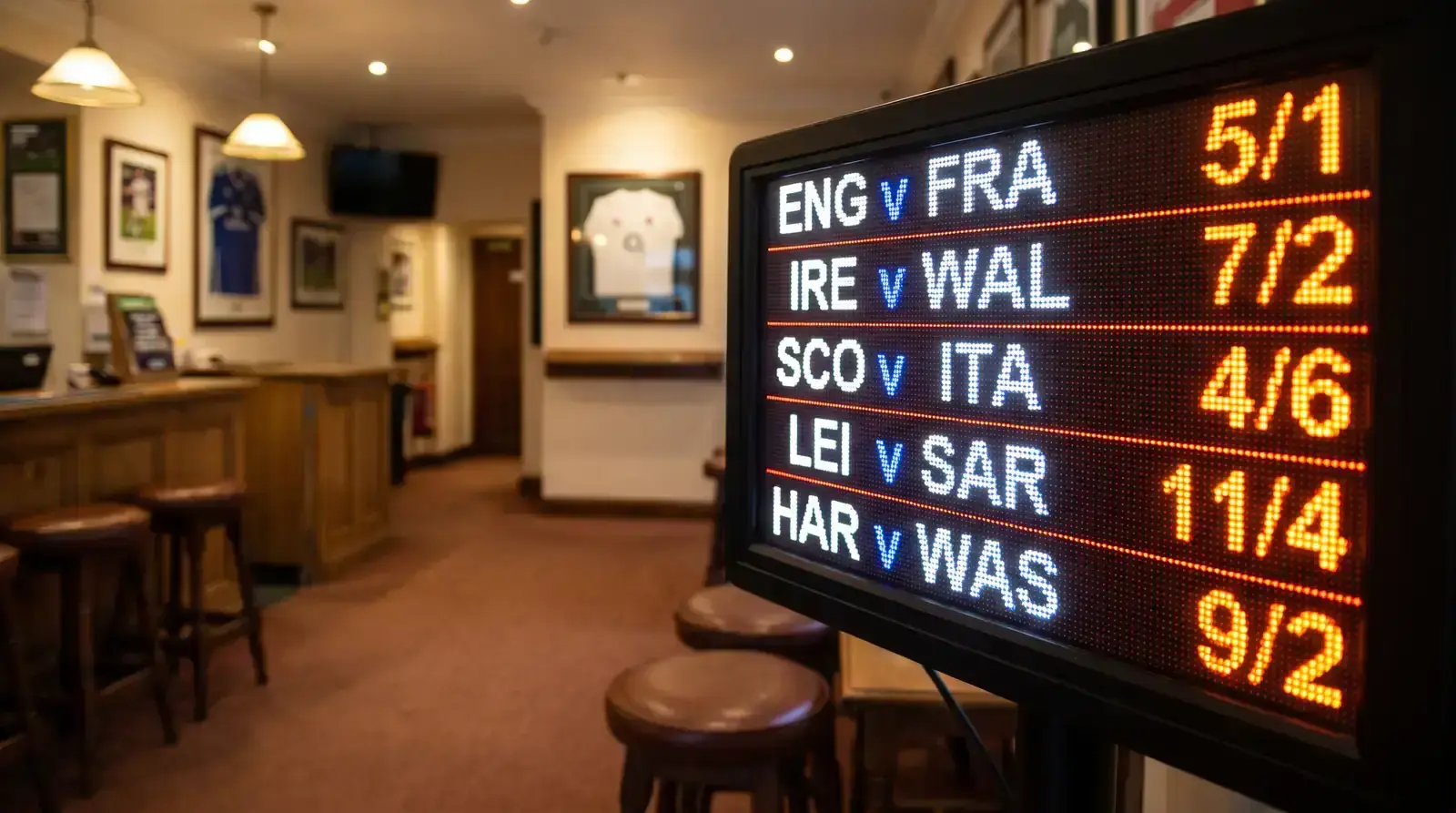
Odds — the price a bookmaker offers on an outcome, expressing both the implied probability of that outcome and the return you receive if it happens. Same price can be written several ways depending on the format.
In the UK, the default display is fractional. A price of 5/2 means that for every two units you stake, you win five units of profit if the bet lands — plus your stake back. The decimal format common across mainland Europe and on most modern apps writes the same price as 3.50, meaning your total return (profit plus stake) is 3.50 times your stake. American moneyline odds — which you will see if you ever stumble onto a US odds feed quoting bet365 — write the All Blacks at +250 and South Africa at +300, where the number tells you the profit on a 100-unit stake for an underdog. All three formats describe identical prices. Get fluent in switching between them and you will never be caught out by a misread board again.
Same price, three formats — New Zealand to win RWC 2027
| Format | Price | What £10 returns if it wins |
|---|---|---|
| Fractional (UK) | 5/2 | £35 (£25 profit plus £10 stake) |
| Decimal | 3.50 | £35 total |
| American moneyline | +250 | £35 total |
Implied probability is where the work starts. Take a decimal price and divide one by it: 1 ÷ 3.50 = 0.286, or 28.6%. That is what the bookmaker is saying about New Zealand's chance of lifting the Webb Ellis Cup. Do the same for South Africa at 3.75 and you get 26.7%. If you add up the implied probabilities of every team in the outright market, the total comes out above 100% — usually somewhere around 115% to 125% on a long futures market. That extra is the bookmaker's margin, the over-round, and it is the structural reason you cannot just back every team and break even.
The other thing odds tell you is the market's confidence. A board that prices the top three teams between 3.50 and 5.00 is signalling a contested race. A board where the favourite is 1.80 and the next contender is 8.00 is signalling a perceived gulf. Reading those shapes is half the job — and a tournament with 24 teams, like the one Australia hosts in 2027, will produce shapes that look quite different to the old 20-team format.
If you want to drill deeper into implied probability, line movement and outright pricing, our dedicated page on Rugby World Cup odds takes the maths apart in detail. For the purposes of this guide, hold on to the three habits: read every price as a percentage, always check the over-round, and remember that the same price can hide in three different costumes.
The Betting Markets You Will Actually See
A common mistake I see from rugby converts who come from football is treating the match winner as the only market. It is the first market on the page, not the only one — and on a Rugby World Cup weekend with mismatches in the pool stage, it is often the least interesting one. Roughly 290 million online bets are placed every month in the UK, and rugby's share of that flow is spread across a dozen or more market types. The point of this section is a tour of the main ones, not a how-to. The step-by-step on placing each bet lives in our walkthrough on how to bet on the Rugby World Cup.

Match winner
The straight result of a single fixture: team A, team B, or — rare in rugby — the draw. The entry-level rugby bet, and the easiest to misprice on a pool blowout.
Handicap
A points start awarded to the underdog (or imposed on the favourite) to balance the market. The standard tool for trading mismatched pool fixtures.
Over/under points
A line set by the bookmaker for the total points scored in the match. You bet over or under. Highly sensitive to weather and refereeing style.
Half-time/full-time
You predict both the half-time leader and the full-time winner. Rugby comebacks are rare, which shapes the pricing.
Winning margin
Bands such as 1-12, 13-24 or 25+ points. A more granular cousin of the handicap.
Try scorer markets
First, last, anytime — for the match — and top try scorer for the whole tournament. The player markets that most casual fans dip into.
Outright winner
The tournament champion. A long-horizon futures market priced months in advance.
Pool / group stage
Pool winner, to-qualify, and stage-of-elimination markets that come into their own in the new 24-team format.
Bet builder
Multiple selections from a single match — for example, England to win, over 41.5 points, and Maro Itoje to be carded — priced as one combined bet.
Over-round — the sum of implied probabilities across all outcomes in a market, expressed as a percentage above 100. The wider it is, the worse the price is for you on average. Outright markets often run wider than match markets.
Each of those markets has its own logic and its own typical depth. Match winner and handicap are where most of the liquidity sits — in other words, where you can place a meaningful stake without the bookmaker visibly flinching. Outright and top try scorer markets are thinner, especially this early in the cycle for 2027, which is why prices on a relative unknown can sometimes look generous and sometimes look insulting on the same day.
A small mental model that has served me well: ask yourself who is on the other side of the trade. For match winner in a Six Nations weekend, you are essentially competing with millions of pub punters and the bookmaker's risk team. For top try scorer for RWC 2027 in early 2026, you are mostly competing with a small group of professional traders and a handful of obsessives. That changes what counts as value.
The other split worth holding in your head is pre-match versus in-play. Pre-match prices are set hours or days ahead and reflect the trader's best model. In-play prices update second-by-second from kick-off and are driven by an entirely different engine — one that reacts to red cards, weather changes, and the simple fact of a five-point swing in score. Most experienced rugby punters use a mix of both. Discovering you prefer one over the other is part of finding your edge.
One last warning before we move on. The number of markets a bookmaker offers on a single match is not a sign of generosity; it is a sign of how much complexity they think they can sell. Pick the markets where you have a real opinion, ignore the rest, and you will already be ahead of most of the field.
Rugby World Cup 2027: Why the Format Changes Everything
The conversation I keep having with fellow analysts about 2027 starts the same way: "Don't bet it like 2023." The instinct from anyone who watched France narrowly miss out three years ago is to project the same shape of tournament onto Australia. That instinct will lose you money. The 2027 edition is the first Rugby World Cup played with 24 teams in six pools of four, with a new Round of 16 stage bolted onto the front of the knockouts. It is structurally a different competition. Pretending otherwise is the single biggest betting mistake on the horizon.

1 Oct – 13 Nov 2027
Tournament dates in Australia
24 teams
Six pools of four, new Round of 16
52 matches
Sydney's Accor Stadium (82,000) hosts the final
2.5m+ tickets
Largest men's RWC ticket allocation in history
The headline facts come straight from World Rugby. The tournament runs from 1 October to 13 November 2027, hosted across seven Australian cities, with more than 2.5 million tickets available — more than any previous men's edition. The semi-finals and final go to Sydney's Accor Stadium, capacity 82,000. The economic case the Australian government built around its successful bid put projected direct visitor spend at AUD$1.3 billion across the host cities, with around 250,000 international visitors expected. Federal tourism minister Simon Birmingham summed up the scale plainly when the bid was confirmed: the Rugby World Cup, he noted, is the second largest single-sport event in the world.
For the punter, three structural changes matter more than any pre-tournament team news.
First, the new Round of 16 stage means more knockout matches than at any previous tournament. That is more fixtures to price, more mismatches early on, and more chances for the kind of upset that used to be reserved for the quarter-finals. Backing favourites blindly through the bracket gets statistically harder when there are 16 knockout games before you reach a final, not eight.
Second, the six-pool structure changes the pool-stage maths. In a pool of four, every team plays three games. A single bad afternoon — a red card, a missed kick — is harder to recover from in three games than it was in four. Pool winner markets become tighter; pool "to qualify" markets become more interesting, because the second qualifier from each pool now joins a Round of 16 rather than a straight quarter-final draw.
Third, the field itself is broader. When the ticket programme went on sale, 18 teams had already qualified. Those last six spots will produce the kind of tournament debutants and surprise pickings that bookmakers historically struggle to price. The early years of the expanded football World Cup showed a similar pattern: bigger field, wider over-round, more uneven trader attention. There is no reason to assume rugby will be different.
Treat RWC 2027 as a new product rather than a sequel. The format change reshapes pools, knockouts and outright prices simultaneously — and the bookmakers know this less than you might assume. The deeper analysis sits in our preview of Rugby World Cup 2027 betting, including format-driven angles and host-city schedules.
I will say something unfashionable in closing. The 2027 tournament is going to be the noisiest RWC for British betting flow yet — there will be no shortage of acca-driven group threads, breathless price-move headlines, and "value pick" lists. Ignore most of them. The advantage is in the format reading, not in the volume of takes.
The Women's Tournament Is a Real Market Now
For most of my career, "women's Rugby World Cup betting" was a sentence that produced a tight smile from the trading desk and a thin set of markets from the bookmaker. That changed in August 2025. The women's tournament hosted across England did something I would not have predicted in 2019: it built a betting market from the ground up in the space of six weekends.
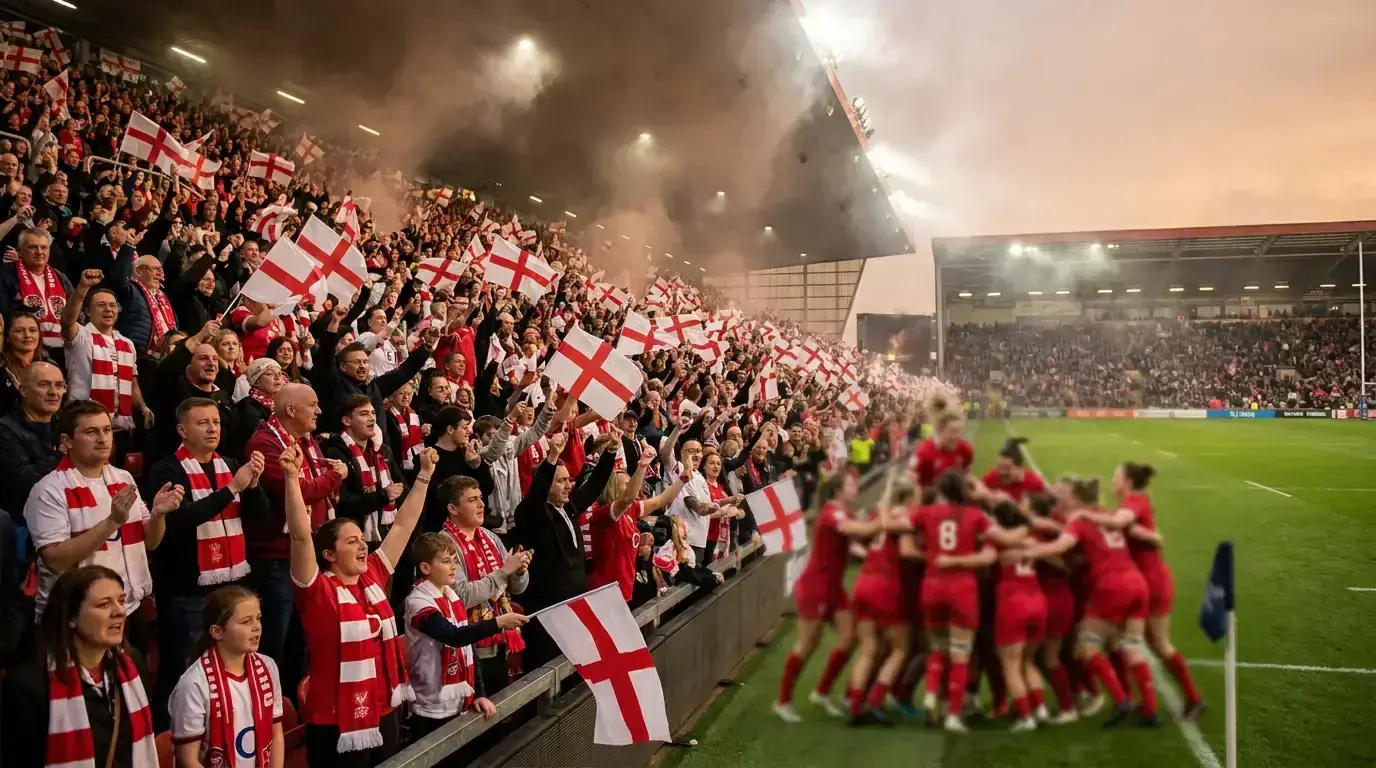
The numbers from the World Rugby Impact Report still take a second look. 444,465 tickets sold across 32 matches — roughly triple the previous edition, with 92% of all available tickets going. The final at Allianz Stadium drew 81,885 spectators, a world attendance record for any women's rugby match. England's win over Canada peaked at 5.8 million viewers on BBC, making it the most-watched rugby match of the year on British television. The opening match in Sunderland drew 42,723 to the stadium and a 2.4 million BBC One peak, with another 600,000 on iPlayer. By Monday morning, the opening weekend's combined audience had already exceeded the entire reach of the previous women's tournament in 2022.
147 million global hours of women's Rugby World Cup viewing in 2025 — a 336% increase on the previous edition. For a sport whose elite women's broadcast existed mostly on YouTube highlights packages a decade ago, that is not a curve. It is a step change.
The pundit Ruby Tui, working as a BBC analyst, put it as bluntly as anyone has: if you could buy shares in women's rugby, it would be your number one investment right now. Strip the bullishness back and the data agrees. 53% of the in-stadium audience were women. Fans travelled from 133 countries. 95% of attendees said they would watch women's rugby again afterwards. None of those numbers describes a one-off novelty.
What this means for betting: women's Rugby World Cup markets are now traded by serious operators, with deeper match-winner liquidity, regular handicap and total points lines, and an outright market that actually moves on team news rather than sitting motionless until the semi-finals. The smaller player markets remain thinner than the men's equivalent, but the headline markets behave like a proper product. Our dedicated guide to women's Rugby World Cup betting goes through the specific markets and the liquidity caveats that still apply.
One word of caution. A young market sometimes prices on reputation rather than form. England's Red Roses sit at the top of the women's pecking order, and have done for years; the temptation is to assume that price reflects all available information. It often does not. The interesting outright value in women's rugby tends to lie one tier below the obvious favourite, where the bookmaker is still working out how to weight a recent Six Nations result against a different team's autumn series. That is the kind of inefficiency I would never expect to see in a mature men's market. For now, it is there.
Where this lands depends on your appetite. If you want every market trading every minute, the men's product is still deeper. If you want a market where the bookmaker is genuinely uncertain and willing to be talked into a price, the women's tournament is the most honest place to find that in 2026.
The 2027 Favourites and What Their Prices Mean
Whenever a friend asks me who is going to win the next Rugby World Cup, I give them the same answer: New Zealand or South Africa, and you do not need me to tell you that. The interesting question — and the one the market actually rewards — is by how much, and what price the rest of the field is being given to upset them.
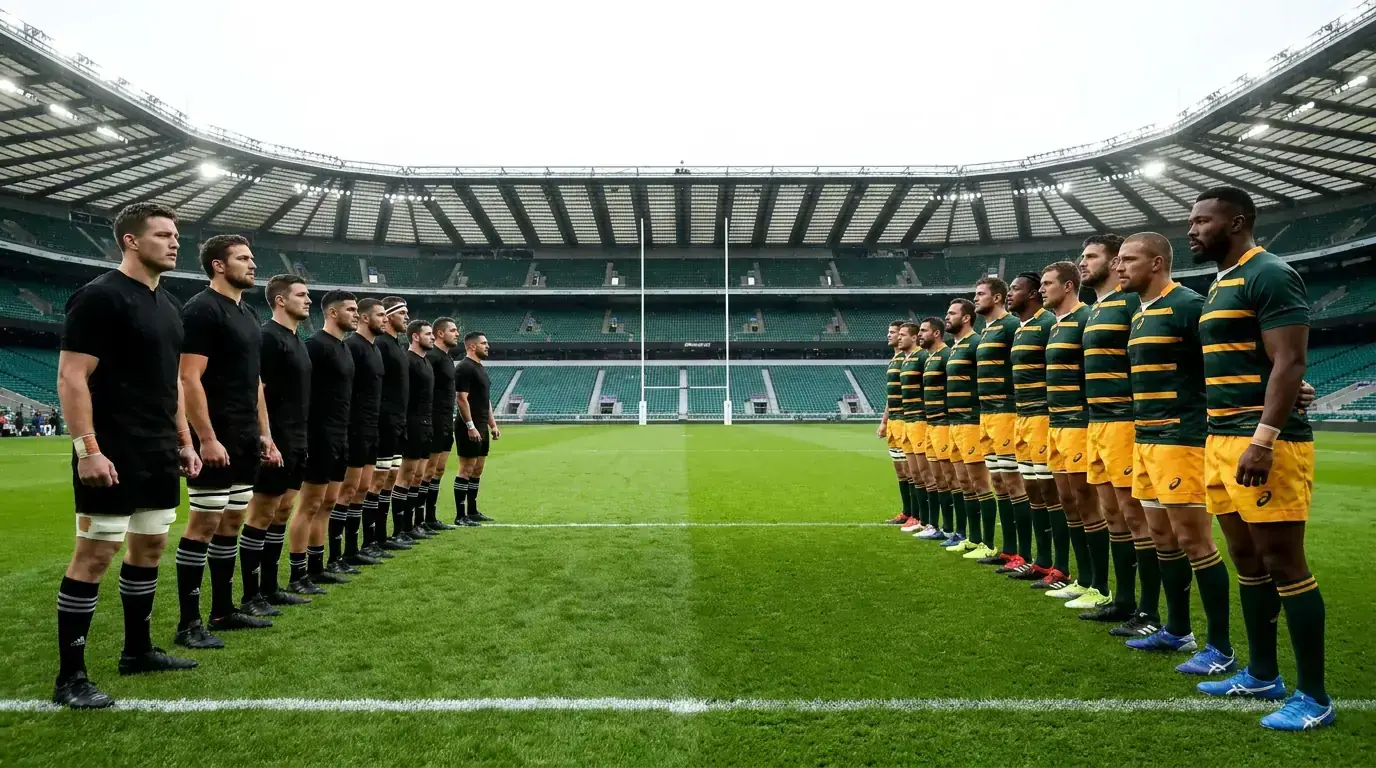
New Zealand
Early decimal price around 3.50. Implied probability roughly 28.6%. The All Blacks have reached the final in seven of the ten Rugby World Cups ever held.
South Africa
Around 3.75 decimal. Implied probability roughly 26.7%. Defending champions and twice winners of the last three tournaments.
France
Implied probability of around 20%. A clear gap to the top two, but well clear of the chasing pack.
The rest
England, Ireland, Australia, Argentina, Scotland — all longer prices reflecting a perceived two-tier gulf at the top of the men's game.
Two facts deserve sitting with for a moment. New Zealand and South Africa have won the last five Rugby World Cups between them, and seven of the ten ever played. The other three titles are split between England and Australia, both more than two decades ago. The implied probability of one of the two Southern Hemisphere giants lifting the trophy, based purely on history, sits above 50% before you have looked at a single team sheet. Anyone selling you a contrarian outright on a third nation is implicitly arguing against a remarkably consistent base rate.
Implied probability from the early 2027 outright board
| Team | Decimal price | Implied chance |
|---|---|---|
| New Zealand | 3.50 | 28.6% |
| South Africa | 3.75 | 26.7% |
| France | 5.00 (illustrative) | 20.0% |
| Top two combined | — | ~55% |
That said, prices move. Tim Miller's point about Britain hosting the largest licensed online market in the world is, among other things, a statement about how quickly information travels through these books. A single Sam Cane retirement, a Springboks coaching change, a French injury crisis — any one of those can shift the top of the outright by 15% in a fortnight. The early-price habit of locking in a position months ahead is a real one, and so is the late-price habit of waiting until after the autumn internationals to see the form lines. Both can be right depending on the punter.
For everyone outside the top three, the most honest framing is each-way territory. England, Ireland and Australia all have rational paths to a semi-final and irrational paths to a final. The format change discussed earlier widens both — there is more knockout rugby to navigate, but also more variance to ride. Argentina, perennially priced as a fourth-tier outsider despite three semi-final appearances in the modern era, is the classic each-way candidate when the place terms are generous.
If I were starting a position today on the outright market, I would not pick a single team. I would build a small portfolio of three or four, sized to my conviction, and accept that the futures over-round means I am playing a long game where exit liquidity through cash-out matters as much as the original pick.
Choosing a Place to Bet — Without the Top-10 List
This is the section where every other rugby betting guide on the internet starts ranking sportsbooks. I am not going to do that. Lists like those are part of the problem, not part of the answer. What I will do is run through what actually matters about the place where your money sits during a Rugby World Cup, so that you can make the choice yourself and so that you can sanity-check whatever choice the marketing machinery is currently pushing at you.

The non-negotiable starts with the licence. A UK Gambling Commission licence is what gives you legal protection, funds-segregation requirements, advertising standards, dispute resolution and a regulator with the power to act if any of those fail. The Commission's register lists 2,179 active operators across the market as of March 2025, and 5,825 licensed betting premises — a substantial pool from which to choose, and the only pool that matters. If a brand is not on that register, it is not a legitimate UK betting operator, no matter how slick the app or how attractive the welcome offer.
Verifying a UKGC licence takes about thirty seconds. The operator must display its licence number prominently in its footer, and the same number is searchable on the Gambling Commission's public register. If the licence is not visible, walk away. If the operator is licensed in another jurisdiction only — Malta, Gibraltar, Curaçao — and is marketing to UK customers, you have a regulatory problem long before you have a betting one.
Once you are inside the licensed perimeter, the question becomes which features matter most for rugby specifically. Mobile experience has overtaken everything else in the UK: 95% of online gambling happens from home, and 76% of 18 to 24-year-olds bet from a mobile phone. If the app freezes during a Twickenham in-play moment, no welcome offer in the world will make up for the missed market. Live streaming matters more in rugby than in many sports because so many RWC kick-off times are awkward UK hours, especially with Australia hosting in 2027. The breadth of in-running markets matters because rugby's flow rewards punters who can respond to a yellow card. And the cash-out tools matter because long-shot outrights can shift value dramatically inside a tournament window.
Feature categories worth weighing — not operators
| Category | What good looks like for rugby |
|---|---|
| Licensing | Visible UKGC licence number; entry on the public register. |
| Market depth | Match winner, handicap, totals, try scorers, outrights — all available for every RWC fixture. |
| In-play | Updated within seconds of on-field events; few prolonged suspensions. |
| Mobile experience | Sub-second bet placement, stable streaming where offered. |
| Player protection tools | Deposit limits, time-outs, self-exclusion, reality checks — all one tap away. |
| Customer support | UK-hours live chat, transparent complaints process. |
Before You Open an Account
- Confirm the UKGC licence on the public register, not just the operator's website.
- Set deposit and loss limits during sign-up, not afterwards.
- Test the app or site with a small initial deposit before committing real Rugby World Cup stakes.
- Read the wagering terms on any welcome offer, especially the qualifying bet requirement.
- Bookmark the responsible gambling and self-exclusion pages.
One subtler point: the offer you see on the front page is rarely the most important part of an operator. Welcome bonuses are designed to win your first deposit, not your fifth year of business. The features that will actually shape your Rugby World Cup experience — settlement speed, the breadth of player markets, whether bet builder selections settle within minutes of full-time — never make it into the marketing copy. The fuller list of selection criteria, and the regulatory background you need to apply them, lives in our guide to Rugby World Cup betting sites.
Staking, Value, and the Maths That Keeps You Solvent
An old colleague of mine had a phrase he used to scare junior traders: "Show me your edge, and then show me what happens to it after you lose twice in a row." It was a joke, but a useful one. Edge in rugby betting only exists if your bankroll exists. The two are not separate problems; they are the same problem.

The first job is to set a bankroll — the total amount you can comfortably lose on Rugby World Cup betting without affecting your life. Not your monthly entertainment budget, not your rent, not your tournament-trip pot. A dedicated number, ideally in a separate account. Once that exists, the second job is to set a unit. A unit is one stake on a standard bet. Most professional rugby bettors set theirs at between 1% and 3% of their bankroll. If your bankroll is £500 for the entire 2027 tournament, your unit is £5 to £15, full stop. No "let's go bigger because it's a final".
A simple value calculation
Say a bookmaker prices England to beat Ireland at decimal 2.20. That implies a 45.5% chance of an England win.
Your own assessment, based on form, head-to-head, weather and squad availability, is that England will win 50% of the time.
Expected value of a £10 stake: (£10 × 2.20 × 0.50) − £10 = £11 − £10 = £1.00, or +10% on stake.
That is what "value" looks like in numbers. Without a probability estimate of your own, you cannot tell whether 2.20 is a good price, a bad price or a fair one.
Notice what the worked example assumes. You need your own probability, not just the bookmaker's. If you do not have one, you are not value betting — you are guessing with extra steps. The Gambling Commission's Survey for Great Britain found that 85% of gamblers cited the chance to win big money as their main motivation, with 72% citing fun. Those are honest motives, and there is nothing wrong with either. They are also not staking plans. The punters who turn rugby betting from a hobby into a discipline are usually the ones who can name a third motive: the maths.
Do
- Define a bankroll and a unit before the tournament starts.
- Estimate your own probability for every bet you place.
- Stick to flat or proportional staking, not "feel".
- Track every bet, including the losers — especially the losers.
- Cash out only when the new price is better than your original edge, not because nerves are talking.
Don't
- Increase stake to chase a loss.
- Bet on every match because there is one on.
- Confuse a strong opinion with a value bet.
- Treat accumulators as a shortcut to a big return.
- Touch the bankroll for a non-betting expense and pretend it did not happen.
Variance is the part nobody warns you about. A 55% strike rate with even prices will still produce four-bet losing streaks regularly across a 52-match tournament. Those streaks are normal; the response to them is what marks out a good punter from a bad one. The good ones widen their notebook. The bad ones widen their stake.
Keeping Rugby Betting Where It Belongs
I have a rule I tell anyone new to this who asks: if you cannot enjoy the match without the bet, the bet is broken. The rule sounds glib. It is not. The Gambling Survey for Great Britain in 2024 found that 2.7% of adults aged 18 and over scored 8 or higher on the Problem Gambling Severity Index, a level that indicates gambling at high risk of harm — statistically stable against the 2.5% recorded a year earlier. Among 18 to 24-year-olds, that figure climbs to 5.3%. The shape of those numbers is important: harm does not affect everyone equally, and the youngest punters are the most exposed.

Player protection in the UK — what is in place
Since 31 October 2024, financial vulnerability checks apply to anyone spending from £150 a month on gambling with a UK-licensed operator. Every licensed sportsbook must offer deposit limits, loss limits, time-out periods, and self-exclusion through GamStop, which blocks access to all UK-licensed operators simultaneously. Reality-check pop-ups remind you how long you have been playing. None of these tools cost you anything to use. All of them work better if you set them before you need them, not after.
If gambling is causing you or someone close to you harm, free, confidential support is available 24 hours a day through GamCare and the National Gambling Helpline. Talking to someone is not a last resort. It is what the tools are designed to make easy.
Beyond the regulator, the Commission's chief executive Andrew Rhodes has been explicit that the survey work behind these numbers exists to deepen understanding of consequences from gambling and to provide insight into risk profiles among those who gamble most frequently. That language is dry, but the implication is not. The data tracks people who are losing badly so that the industry can be pushed to do something about it. Treat the player-protection tools as part of the product, not as small print. They are not a sign that the operator is worried about your behaviour; they are a sign that the operator is required to give you the means to manage it.
The practical version of all of this fits on a sticky note. Set a deposit limit. Set a session length. Walk away when one of them hits, even when — especially when — the next bet feels obvious. Rugby World Cups come round every four years. Yours will still be there next time.
Common Questions Before the First Whistle
How do you bet on the Rugby World Cup?
Open an account with a UK Gambling Commission-licensed sportsbook, deposit funds within a limit you have set yourself, choose a market from the operator's Rugby World Cup pages, enter a stake, and confirm the bet. The bet is settled when the underlying event — a match, a tournament stage, or the final itself — resolves. The hard part is not the mechanics; it is choosing which market to bet on and at what price.
Who are the favourites for the 2027 Rugby World Cup?
New Zealand and South Africa head the outright market by a clear margin, priced at around decimal 3.50 and 3.75 in early 2026. France sit in a clear third tier, implying a roughly one-in-five chance of victory. England, Ireland, hosts Australia, and Argentina populate the next group of prices. Between them, New Zealand and South Africa have won the last five Rugby World Cups and seven of the ten ever played.
When and where is the next Rugby World Cup held?
The men's Rugby World Cup 2027 runs from 1 October to 13 November 2027, hosted across seven cities in Australia. The semi-finals and final take place at Accor Stadium in Sydney. Before then, the women's Rugby World Cup 2025 in England has already concluded — and was the largest women's rugby event in history, with 444,465 tickets sold across 32 matches.
What betting markets are available for the Rugby World Cup?
The core markets are match winner, handicap, over/under points, half-time/full-time, winning margin, try scorer markets, pool winner and qualification, the outright tournament winner, and the bet builder for combining selections within one match. Pre-match prices are offered for every fixture; in-play markets open at kick-off and close at full-time, with momentary suspensions around scoring events.
What is the difference between fractional and decimal odds?
Fractional odds — for example 5/2 — show profit relative to stake: a £10 bet at 5/2 returns £25 profit plus the £10 stake. Decimal odds describe total return as a multiplier: the same price is 3.50, meaning a £10 bet returns £35 in total. Most UK operators let you switch between the two formats in your account settings. The prices are mathematically identical; only the display changes.
Is online rugby betting legal in the UK?
Yes, provided the operator holds a UK Gambling Commission licence and you are aged 18 or over. Winnings from sports betting are not subject to personal income tax in the UK — the duty is paid by the operator. Identity and age verification are mandatory at sign-up, and additional financial-vulnerability checks apply to monthly spend from £150 since the regulation update in October 2024.
How can I keep Rugby World Cup betting under control?
Set a bankroll for the whole tournament before it starts, divide it into units of 1–3%, and stake in those units regardless of how confident you feel. Use the deposit limits, loss limits, time-outs and reality-check tools that every UK-licensed operator is required to offer. If betting is causing harm, GamStop self-exclusion blocks access to all UK-licensed sportsbooks at once, and free support is available around the clock through the National Gambling Helpline.
