


Why I refuse to give people a ranked list
I get asked at least twice a week which sportsbook is best for the Rugby World Cup. My answer disappoints people every time, because I refuse to give a ranked list. Not because I do not have opinions (I have plenty) but because “the best site” is the wrong question. The right question is: which sites meet a set of non-negotiable criteria, and among those, which suit how you specifically bet? A site that is perfect for someone who lives in the outright market is mediocre for someone who only bets in-play. A book with excellent live streaming is irrelevant if you mostly play accumulators on Sunday lunchtimes.
The British market has 2,179 licensed operators as of the most recent regulator data, with the number actually shrinking — down 3.7 per cent year on year. Many of those are not consumer-facing sportsbooks, but enough are to make the choice meaningful. Among the consumer-facing names you would recognise, perhaps fifteen offer Rugby World Cup markets at a level worth taking seriously. The job of this article is to give you the framework for evaluating any one of them properly, rather than handing you a list that will be out of date in eighteen months.
I want to cover what a UK Gambling Commission licence actually means and why it should be your first filter, the features that matter specifically for rugby betting, how to read welcome offers and promotions without getting fooled by the headline number, the safety and control tools every UK-licensed site must offer, and the red flags that should make you walk away before depositing a penny. None of this is glamorous. All of it is more valuable than any “top ten” list you will read elsewhere.
What a UK Gambling Commission licence actually means
The first filter is binary. Is the operator licensed by the UK Gambling Commission, or is it not? If it is not, the conversation ends there. Everything else in this article assumes a UK-licensed operator, because the protections that follow are built into the licence itself.
What the licence actually requires of the operator is more substantial than most punters realise. Customer funds must be held in a way that protects them in the event of operator insolvency. Identity verification must be completed before withdrawals. Age verification (minimum 18) must be carried out at sign-up. Marketing materials must not target minors or vulnerable individuals. Operators must contribute to research, prevention and treatment of gambling harm. Complaints procedures must be transparent and operators must engage with the independent dispute resolution providers the Commission accredits. None of this is optional.

The wider regulatory environment is the largest licensed online market in the world. Andrew Rhodes, the chief executive of the Gambling Commission, captured the principle behind it when he described the Commission’s evidence-gathering work as “the largest survey of its kind in the world”, and the rigour applied to evidence is matched by the rigour applied to licensing. Operators in this market are scrutinised harder than in almost any comparable jurisdiction.
The regulated industry generated 16.8 billion pounds of gross gaming yield in the year to 31 March 2025 — a 7.3 per cent increase. That figure tells you the scale of activity, but the more useful number for our purposes is that the number of licensed betting offices fell 1.8 per cent to 5,825, the eleventh consecutive year of decline. The industry is consolidating around online operators, which is exactly where Rugby World Cup betting is concentrated. The high street book that your father used is increasingly not where this action lives.
Verifying a licence takes about thirty seconds. Every UK-licensed operator displays its licence number in the footer of every page. Click through and you reach the Gambling Commission’s public register, which shows the licensee’s full legal name, status (active, surrendered, revoked), the activities they are licensed for, and any conditions attached. If the licence number is missing, hidden, or links to nothing on the official register, that is not a UK-licensed site, regardless of what the homepage says. Sites operating in the UK without that licence are operating illegally, and “they let me sign up” is not protection.
One specific point on crypto-only betting sites. They are mostly not UK-licensed. Some are licensed in offshore jurisdictions like Curaçao or Malta and accept British customers in apparent breach of UK law. The marketing is slick, the promotions look generous, and the legal status is a mess. If something goes wrong — a dispute, a withdrawal block, account closure — you have no UK regulatory recourse. I have watched people lose five-figure sums to these operators and have no path to get the money back. Avoid them entirely.
The features that matter specifically for rugby
Once you have filtered for proper licensing, you can start looking at what makes a sportsbook genuinely useful for Rugby World Cup betting. The features that matter are not the same as the features that matter for football or horse racing, and the books vary significantly in what they offer.
Market depth is the first thing I check. Does the operator price up the full pool stage, or only the marquee matches? Are handicap and totals lines available on every fixture, or only the top tier? How many in-play markets do they offer per match? A book that offers ten markets per pool stage fixture is a fundamentally different product from one that offers thirty. The wider the menu, the more options you have to express a specific view at a competitive price. Books with thin menus push you towards their margin-heaviest products by default.
Live streaming matters more in rugby than in many sports because so much betting analysis is visual. A scrum dominance you can see on the screen is information you cannot get from the running score. UK-licensed books vary enormously on this — some stream every Rugby World Cup match, some stream none, some only stream if you have an active bet on the fixture. If you bet in-play, the streaming offer is not a luxury, it is a core feature.
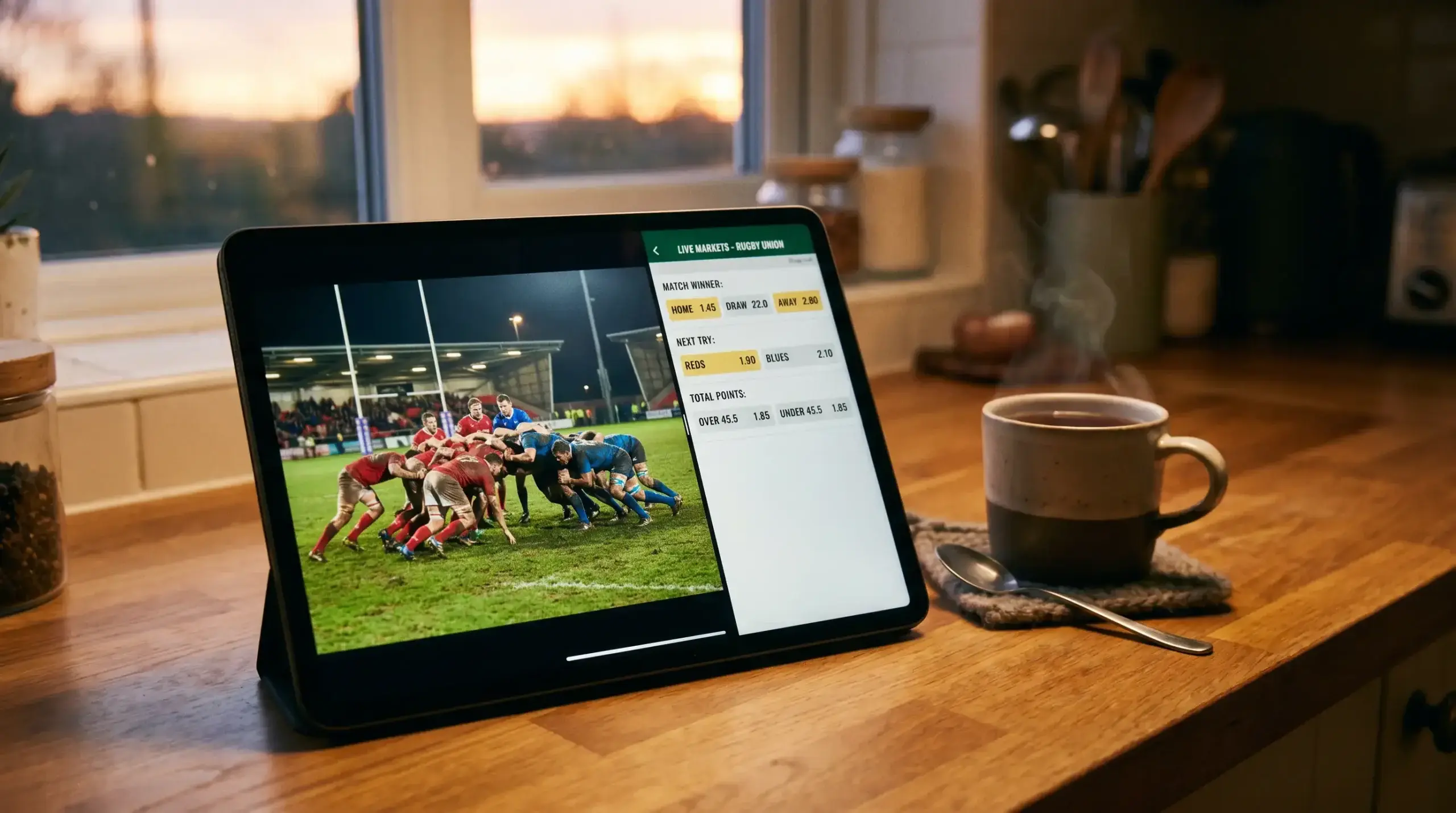
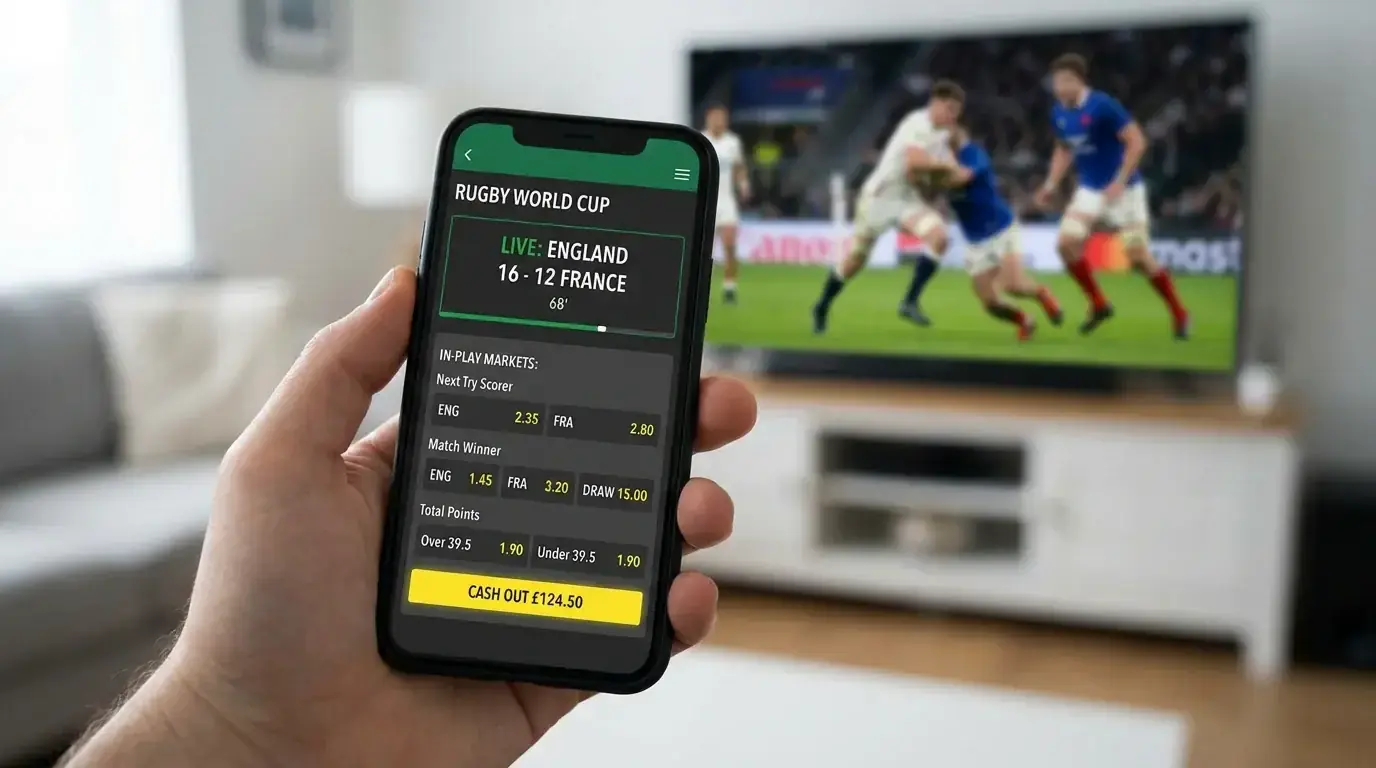
Cash-out availability and quality is the third feature I check. Every UK book offers some form of cash out, but the quality varies. The best ones offer partial cash-out, automatic cash-out triggers you can set in advance, and reasonable cash-out values that do not strip out absurd amounts of expected value. The worst ones offer cash-out only on a subset of markets and at terms so penal it is barely worth the click. The pricing of cash-out at a book is a quiet signal of the overall margin philosophy of the operator.
The remote casino, betting and bingo segment generated 7.8 billion pounds in 2025 (up 13.1 per cent year-on-year) which is exactly why the books take the digital product seriously. That growth is funding investment in features. The competitive pressure between operators for that revenue is what gives bettors choice. Use it.
Mobile experience is the fourth feature, and frankly the one I would weight heaviest for most punters. Among 18 to 24 year olds in Britain, 76 per cent bet from a phone, and the wider population is moving the same direction. A book with an excellent desktop site but a clunky mobile app will frustrate you within a tournament. Test the app before you fund the account. Place a low-stakes bet, navigate the live betting screen, try cash-out, attempt a withdrawal. If any of those feel awkward, the bigger bets will be worse, not better.
Finally (and this is more subtle) pay attention to how the book handles ante-post outright bets. Some operators allow you to settle long-running outright positions cleanly. Others bury you in fine print about what happens to your bet if a team withdraws, gets disqualified or the format changes. Rugby World Cup outrights are six-week to three-year commitments. The terms governing them matter more than the headline price.
How to read offers and promotions without getting fooled
Welcome offers are the loudest part of any betting site’s marketing. They are also the most consistently misleading. “Bet 10 pounds, get 30 in free bets” is a real offer at real UK-licensed books, and it is not what most new bettors think it is. Understanding the actual mechanics protects you from disappointing yourself.
The structure almost always works the same way. You place a qualifying bet (typically a minimum stake at minimum odds) and after it settles, the operator credits you with free bets to a stated value. The qualifying bet is real money at risk. The free bets are not cash; they are tokens you can stake, and if a free bet wins, you keep the winnings minus the stake itself. So a 10-pound free bet at decimal odds of 3.00 returns 20 pounds, not 30 pounds — because the stake on the free bet is retained by the book rather than returned to you.
Then there is the small print. Free bets often expire within seven days. They can only be used on specific markets, sometimes only on accumulators, sometimes only at minimum odds. Some have wagering requirements before any winnings can be withdrawn. None of this is automatically bad, but it does mean a “30 pounds free” offer is rarely worth 30 pounds in real terms. Net value, after taking the qualifying bet expectation, the stake-not-returned mechanism, the expiry, and any minimum odds requirement, typically comes to between three and twelve pounds of expected value depending on the operator and the specific terms.

The fourth quarter of 2025 saw the industry generate 4.5 billion pounds in gross gaming yield, and a meaningful chunk of that came from new customer acquisition. Books spend heavily to acquire you because they know the long-term value of a customer is significantly higher than what they pay to bring you in. The offer is rational on their side. Your job is to evaluate it on yours.
Andrew Rhodes once said of the regulator’s findings that they should encourage operators “to use this evidence” to better protect customers — and the same evidence base is what underpins the rules around how welcome offers are marketed. The Commission has tightened what operators can say in advertising over the past several years. Phrases like “free bet” must be qualified with the relevant terms. “Risk-free” claims are heavily restricted. If you see an offer that promises returns without conditions, you are either looking at an unlicensed site or you are misreading the offer.
My practical advice: never let a welcome offer be the reason you choose a sportsbook. Pick the book on the basis of licensing, market depth, mobile experience, and how its day-to-day product fits your betting style. If the book also happens to have a worthwhile welcome offer, that is a bonus. The relationship is going to last years, and welcome offers expire in weeks. Optimise for the long-term fit. The detailed breakdown of how free bets really work in practice — qualifying bets, stake-not-returned mechanics, and the small print most punters never read — sits in my deeper guide to how Rugby World Cup free bet offers actually pay out.
The safety and control tools every UK site must offer
This is where the UK regulatory framework genuinely earns its reputation. Every UK-licensed operator must offer a specific set of customer protection tools, and the punters who use them most actively are the ones who stay in control over the long run.
Deposit limits are the foundation. Every site must let you set a daily, weekly and monthly deposit cap. Reductions take effect immediately. Increases are deliberately slow (typically a 24-hour cooling-off period before a higher limit applies) which gives you time to second-guess the decision. Set a deposit limit when you open the account, before you have any emotional attachment to the platform. Adjust it down if you find yourself nudging against it. The system is built to help you, but only if you use it.
Loss limits and stake limits work similarly. Some sites also offer session time limits, which trigger a forced pause after a set period of active play. Time limits matter more for casino products than for rugby betting, but they are available across most sites and worth using if you find yourself losing track of time during in-play markets.
Reality checks — pop-up notifications that remind you how long you have been logged in and how much you have staked — are mandatory and on by default. Some users find them annoying. Those are exactly the users who most need them.
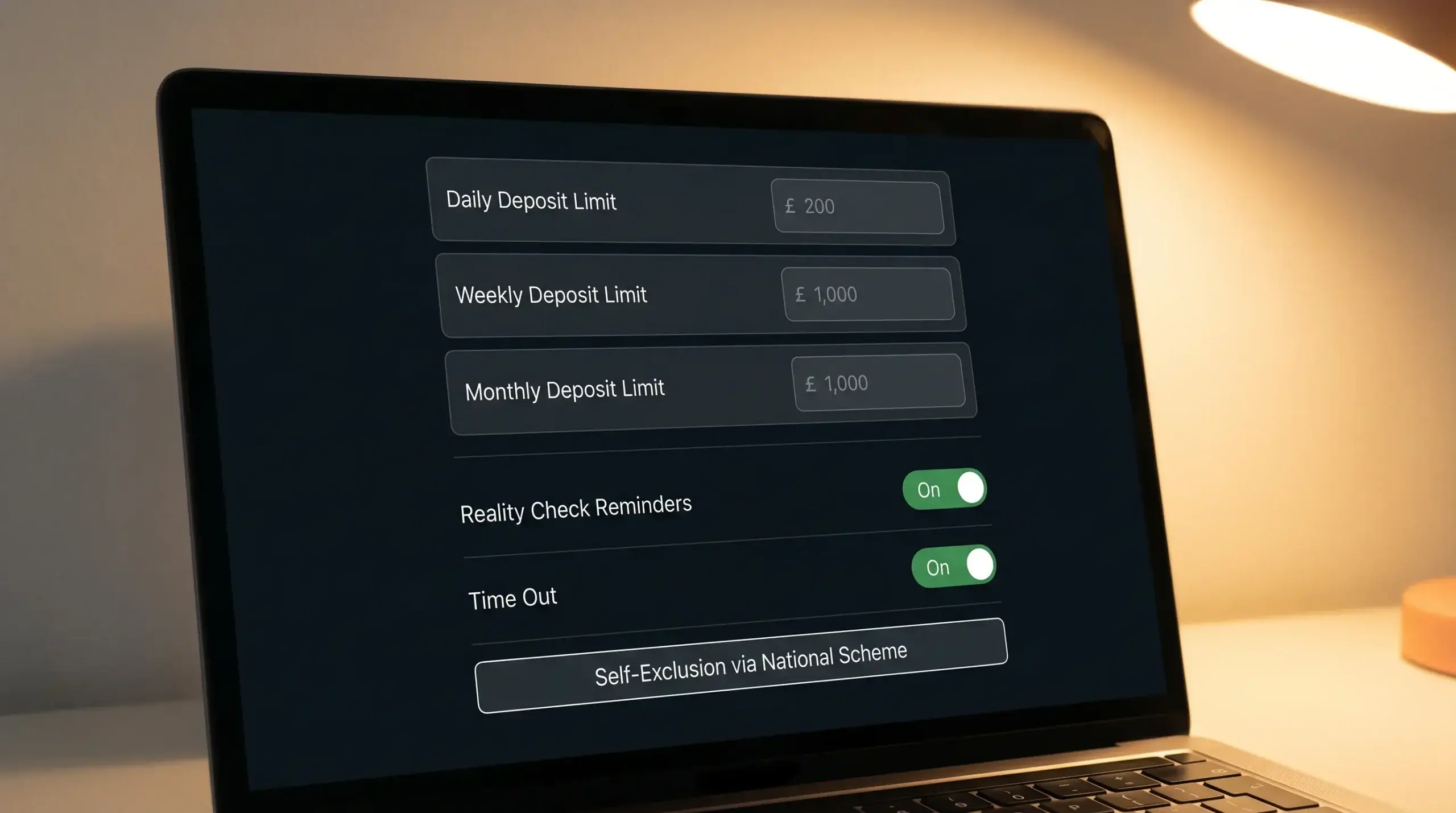
Self-exclusion is the heaviest tool. Every UK-licensed site lets you self-exclude from that specific operator. GamStop, the national multi-operator self-exclusion service, lets you block yourself from all UK-licensed operators with a single registration. Self-exclusion periods range from six months to five years, and during the period you are excluded, your accounts are locked and the operator cannot solicit you. It is the cleanest emergency brake the system offers.
The Commission introduced financial vulnerability checks from 31 October 2024 for customers spending over 150 pounds a month. These checks happen quietly in the background — the operator runs a frictionless review of public information — and only escalate to actual customer contact if there are specific indicators of concern. If a book asks you for additional information about your finances, that is the framework working as designed, not the operator being unreasonable.
One last point on safety. The Gambling Survey for Great Britain found that 2.7 per cent of adults in the UK in 2024 scored 8 or more on the PGSI problem gambling index, with the highest rate of 5.3 per cent among 18 to 24 year olds. Those numbers are not abstract. They mean that for every twenty people you know who gamble, at least one is somewhere on the problem gambling spectrum. The control tools exist because they work. If you have ever felt you were betting more than you wanted to, the tools are one click away. Use them before you need them.
The red flags that should send you elsewhere
I have one last category of guidance, which is the warning signs that a site you are considering is not worth your custom regardless of how slick the marketing is. Some of these are technical. Some are softer. All of them have, at one time or another, signalled to me that I should walk away.
The first red flag is missing or unclear licensing information. A UK-licensed operator wants you to see the licence — it is a competitive advantage. If you have to dig to find the licence number, or it links to a registration in a different jurisdiction than what the homepage implies, treat that as the site telling you something it does not want to say out loud.
The second is welcome offers that are dramatically more generous than what the rest of the market is offering. Every UK book operates within similar regulatory bounds on advertising. If one operator is offering “200 pounds free, no deposit required” while everyone else is offering bet 10 get 30, that operator is either misrepresenting the offer or operating outside the UK framework. Andrew Rhodes captured the relevant principle when he encouraged operators to use the Commission’s evidence base properly — “we strongly encourage operators to use this evidence” — and offers that ignore the framework usually come from operators not bound by it.
The third red flag is poor customer support during the sign-up process. If the verification process is slow, communication is unclear, or your initial questions go unanswered, the same problems will be worse when you have actual money at stake and need help fast. Test customer service before you fund the account. Send an email with a routine question. See how long the reply takes and how substantive it is.
The fourth is restrictive terms on withdrawals. Some sites have surprisingly aggressive minimum withdrawal amounts, slow processing times, or fees that are not clearly disclosed. Read the withdrawal terms in detail before you deposit. A book that makes it easy to put money in and hard to take it out is telling you something.

The fifth, and perhaps the most quietly important, is the way a site handles winning customers. Every operator has the right to apply stake limits to individual accounts, and those limits are typically tightened for customers who consistently win. That is a commercial decision and not, in itself, illegitimate. But the manner in which it is done tells you a lot. Operators who quietly and aggressively limit winners tend also to be operators with other restrictive practices. The community of British professional bettors has long memories about which books treat sharper customers fairly.
If you are starting fresh on a new betting site for the Rugby World Cup, my honest advice is to spend the first month placing small bets, testing the limits, sampling the customer service, withdrawing small amounts to confirm the process works, and only scaling up if everything has been smooth. The 13.5 million average monthly active online accounts in the British market in early 2025 reflect a healthy, competitive industry where you have real choice. Use that choice. Move sites if the one you tried is not working for you. The cost of switching is low. The cost of staying with a poor fit is high.
