

The promotion that looks better than it usually is
The first time I took a price boost on a Rugby World Cup match, I cashed it and felt clever for the rest of the weekend. The boost was on a favourite at “8/1 instead of 5/1” — eyewatering on paper. What I had not done was check the stake cap, which was £5. I would have happily put £30 on the same selection at the standard 5/1, but the boost capped me at £5 at 8/1, so I made less money on a successful slip than I would have on the unboosted version. The promotion that looked like a bonus turned out to be a constraint.
Enhanced odds — variously called price boosts, odds boosts, enhanced specials — are a category of promotion where the bookmaker temporarily lifts a published price above its standard line. The boost is real money. The slip pays more if it wins. But almost every boost comes with terms that meaningfully reduce its value compared with the headline number, and the marketing rarely makes those terms visible until you click through.
This article is about reading boosts the way the bookmaker reads them — as a marketing tool with carefully constrained downside — rather than the way casual punters read them, as a gift from the operator.
What a price boost actually is
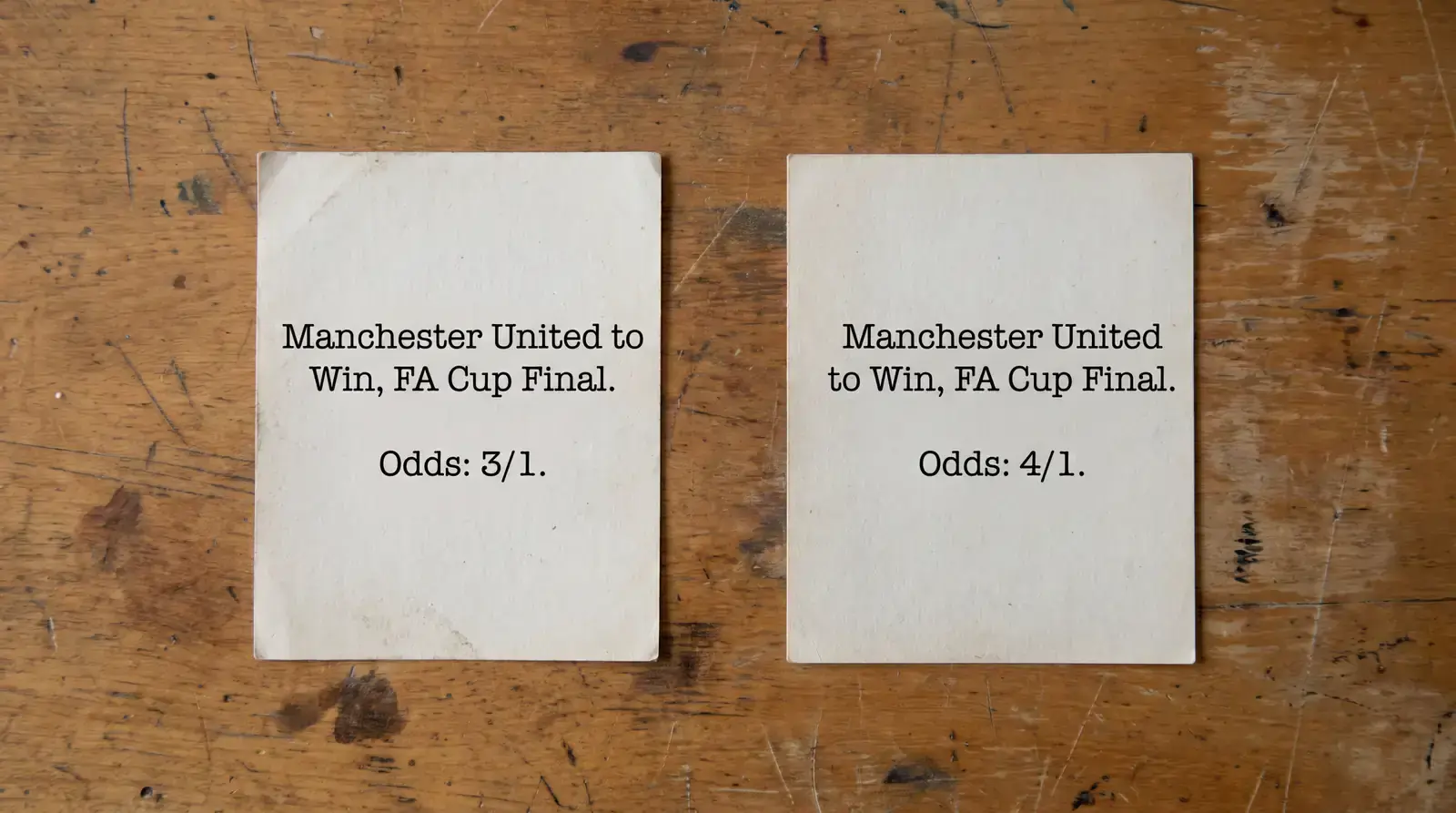
The mechanic is simple. The book identifies a selection, publishes its standard price, then overwrites that price with a higher one for a limited window. The boost is advertised as the headline “from X to Y” comparison. The standard price might have been 4.00 (3/1 fractional). The boosted price might be 6.00 (5/1). The numerical difference is real — a successful slip pays back 50% more than at the standard price — but the boost rarely comes alone.

The conditions vary by operator and by specific boost. Stake caps are the most common — typically £5, £10 or £20 maximum. Customer eligibility restrictions are second — many boosts are limited to specific customer groups, or come with the requirement of a prior qualifying bet. Settlement restrictions are third — some boosts pay the standard price into the cash balance and the enhancement portion as a free bet, which has its own wagering conditions before withdrawal.
The bookmaker’s view of a price boost is straightforward. It is a marketing cost the operator absorbs in exchange for customer acquisition or retention. The cost is real, but the operator controls every parameter of how much it will actually pay out. The stake cap controls the maximum exposure per slip. The eligibility rules concentrate the offer on the customer behaviours the operator wants to reward. The settlement structure ensures that even paid-out boosts get partially clawed back through wagering requirements on the free-bet portion.
Around 13.5 million online accounts are active across the UK in a typical month, and a substantial share of marketing budget at every major operator is now spent on this category. The format is sticky — boosts encourage more frequent app opens than almost any other promotional tool — and the volume of boosted slips placed during a major tournament reflects exactly that. Recent online quarterly GGY in the UK has been growing at around 7% year on year, with much of the growth coming from in-product promotional engagement of which boosts are a major component.
Reading the terms before the headline
The first habit on any boost slip is to check the stake cap before doing anything else. The headline “5/1 boosted to 7/1” is meaningless without knowing what stake is permitted. A £5 cap on an enhanced 7/1 returns £30 more than the same £5 at standard 5/1. That is the actual upside of the boost. Treating the boost as if you could stake your normal unit on it gives you a fantasy upside you will not get to use.
The second habit is reading whether the boost is a “win and place free bet” arrangement or a straight enhanced price. Some operators pay the original price in cash on a successful slip and convert the enhancement to a free bet. The free bet then has standard wagering requirements — typically the stake is not returned on a winning free bet, and the bet has to be staked at minimum odds within a set timeframe. The effective value of a £20 free bet is closer to £12 to £15 after wagering, not £20.
The third habit is checking the eligibility window. “New customers only” boosts are not available to most readers. “Within 24 hours of registration” boosts vanish after a day. “Loyalty member” boosts apply only to specific customer tiers. The boost that looks open to everyone often is not.
“This year’s findings deepen our understanding of consequences from gambling and provide crucial insight into risk profiles among those who gamble most frequently. We strongly encourage operators to use this evidence”, said Andrew Rhodes, the Gambling Commission’s Chief Executive, in commentary around the most recent Gambling Survey for Great Britain. The point applies directly to boosts — the operators most aware of their customers’ behavioural patterns are the ones designing the most carefully constrained promotional structures, and the terms reflect that.
For a deeper read on how promotional structures interact with the underlying free bet mechanics, the free bet market is the natural read alongside this one. The two products share most of their underlying mechanics.
Boost versus the base price
The question that determines whether a boost is genuinely worth taking is straightforward: is the boosted price now actually value? The boost shifts the price upward. That shift can either close a gap that already favoured the bookmaker (making the slip fair, or near-fair) or it can open a gap that favours the punter (making the slip genuinely positive expected value).
If the standard price was 4.00 — implying 25% probability — and you believe the actual probability is 22%, the standard price has negative expected value for you. A boost to 4.50 (implying roughly 22%) brings the slip closer to break-even but still does not make it a clear winner. A boost to 5.50 (implying roughly 18%) would put the slip into value territory. The boost is not value in itself. It is a movement that might or might not cross the line.
This framing matters because the bookmaker is not boosting random selections. The boosts most often go to selections the book wants to encourage volume on — heavy favourites in headline matches, popular underdogs in narrative-heavy fixtures, big-name players in prop markets. The underlying selections are often the ones where the public’s preferred slips already trade at low expected value. The boost pushes them closer to fair, which is better than worse, but rarely far enough into positive value to be a no-brainer.
The shopping habit applies more strongly here than anywhere else. Operators compete on boosts, and the same selection is occasionally boosted by multiple books at the same time at different rates. A boost to 5/1 at one book and 9/2 at another on the identical selection is a meaningful difference, and the punter who checks both saves real money.
The slips where boosts actually deliver
Boosts have a place in a serious punter’s slip strategy, but the place is narrower than the marketing suggests. Two categories of boost genuinely deserve attention.

The first is enhanced multiples — accumulators where the boost applies to the combined price of three or more legs you were going to back anyway. The slip becomes the same accumulator with a slightly better price. The combined enhancement on a four-leg slip can be material — 10 to 20% on the combined return — and the slip’s underlying maths is unchanged. If you were going to place that exact acca regardless, the boost is a clean upgrade.
The second is “winning margin” or other multi-band markets where the operator has boosted a specific band to a level that crosses into value territory. The bookmaker’s boost calculator does not always update the entire distribution — boosting a 9/2 band to 6/1 occasionally creates an arbitrage opportunity with the unboosted neighbouring bands. These windows are short-lived and require active monitoring, but they happen.
The boosts that do not deserve attention are the headline “request a bet” boosts on highly specific outcomes. These are entertainment slips by design — “Team A to win, both teams to score a try, three or more yellow cards in the match”. The boost on these is real, but the underlying selection was such bad value to begin with that even the enhanced price still favours the bookmaker. The marketing structure for these slips is excellent. The mathematical structure rarely is.
My personal habit is to keep one app open with boost notifications enabled, scroll through them at the start of each pool weekend, and reject 90% of them. The 10% that survive are usually multiples I was already going to place, or single-leg boosts on selections where I had an independent value read. The remaining boosts are someone else’s slip to take.
What price boosts cannot do
A boost cannot make a bad selection good. It can make a slightly negative slip break-even, or push a slightly positive slip into clearer value, but it does not change the underlying probability of the outcome. A boost on a selection you would not have backed at the original price is rarely justification to back it now. The bookmaker has accounted for the boost in the slip’s overall economics, and the boost is a marketing cost they have decided is worth absorbing precisely because they expect to make money on the volume of slips it attracts.
A boost also cannot fix poor staking. A heavily boosted slip at a stake cap that is too small to be meaningful is still essentially a marketing exercise. The lift is real but capped, and the cap is set by the operator at a level that makes the boost cost-effective for them. Sizing your stake to the cap on every boost will produce smaller and smaller incremental returns relative to the time spent finding the boosts.
The discipline that keeps boost hunting useful is the same discipline that keeps all betting profitable — slip-by-slip evaluation of whether the price now offered represents value, regardless of how it was advertised. The boost is information. The slip is the bet. The two are not the same.
