

What a first Rugby World Cup bet usually gets wrong
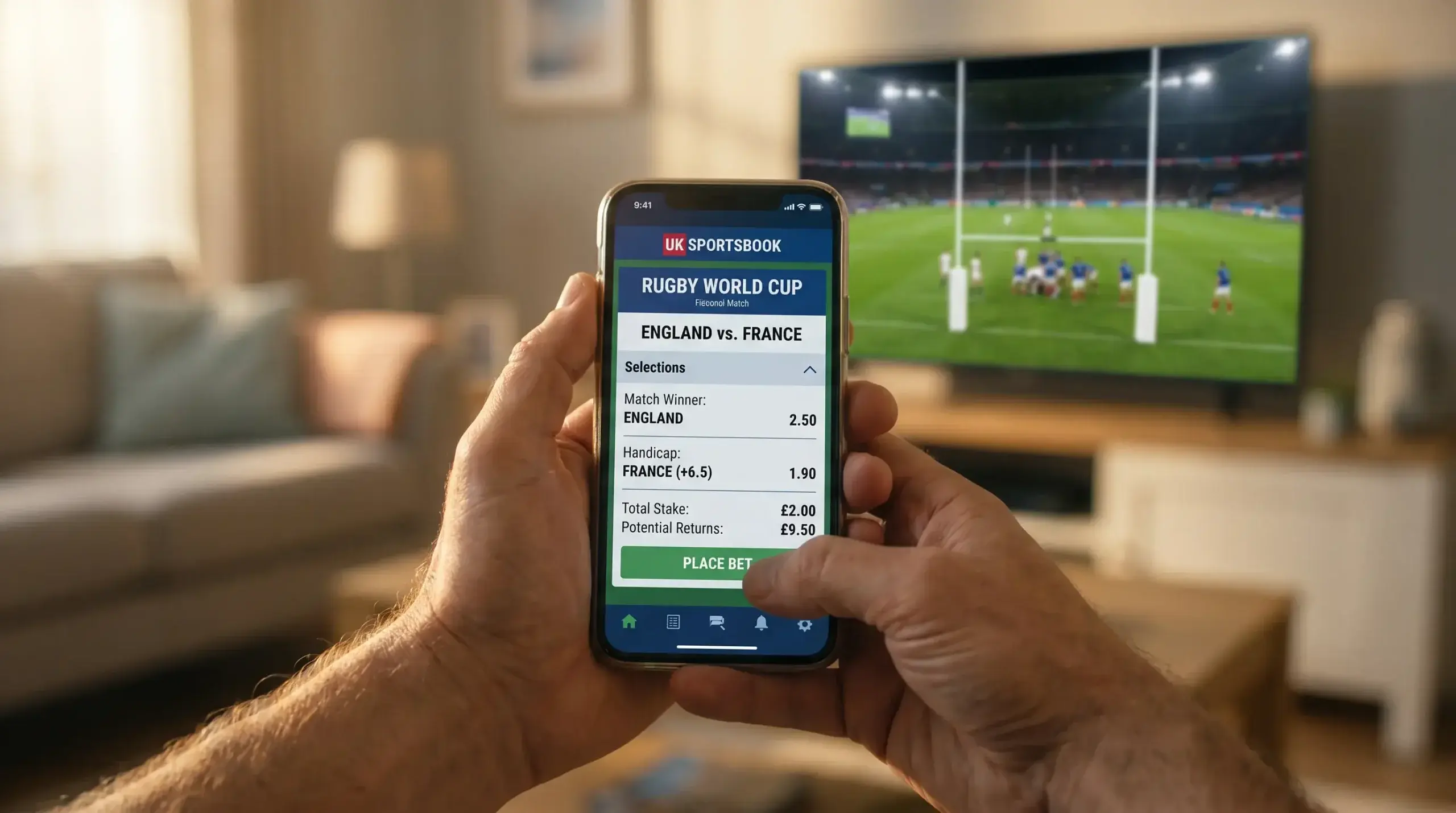
A friend asked me last autumn to walk him through placing his first ever Rugby World Cup bet. He had been a casual football punter for years, occasional acca on a Saturday, nothing serious. Within ninety seconds of opening his sportsbook app, he had built a six-leg accumulator that mixed match winners, try scorers and a half-time leader, staked it at twenty quid, and was waiting for me to say “go on then”. I asked him to put the phone down.
That story is not unusual. Football betting is the gateway: it makes up roughly 1.1 billion pounds in gross gaming yield in the British market and around 6 per cent of all adults bet live on a match each week. People bring those instincts straight into rugby and assume the mechanics are identical. They are similar, but the differences are exactly where new bettors leak money. The pace of scoring is different. The variance in score lines is wider. The set-piece moments swing games in ways football rarely does.
This guide is the slow version of that conversation I never quite got to have. I want to take you from setting up an account properly through to the practical mechanics of every major Rugby World Cup market — match winners, handicaps, totals, outright bets, bet builders and accumulators — with the kind of detail I wish someone had given me when I first started betting on this sport. We will finish with the mistakes I see new punters make every single tournament. None of it requires a model or a spreadsheet. It does require slowing down for ninety seconds longer than my friend did.
Getting set up properly before you stake a penny
The temptation, especially in the days running up to a big Rugby World Cup fixture, is to find a price you like and rush an account open. Do not. The fifteen minutes you spend setting yourself up properly are the cheapest fifteen minutes you will spend on this tournament.
Start with the licence. Any sportsbook you use from a British address should hold a UK Gambling Commission licence. That is non-negotiable. The licence number sits in the footer of the site, usually with a clickable link to the operator’s entry on the regulator’s public register. If a site cannot show you that within five seconds of looking, leave. The fact that 95 per cent of online gambling activity in the UK happens from home means the regulator’s protections only travel with you if the operator is properly licensed.
Account verification is the next step, and people resent it because it feels intrusive. Photo identification, proof of address, sometimes proof of funds, all of it required, all of it reasonable. Get it done before you fund the account, not when you are trying to withdraw your first winning bet at midnight on a Sunday. I have seen punters lose access to legitimate winnings for a week purely because they had not bothered to complete verification at the start.

Mobile or desktop? Among 18 to 24 year olds in Britain, 76 per cent bet from a phone, and the wider population is not far behind. I would not argue against that (modern sportsbook apps are perfectly capable), but I do my own pre-tournament analysis on a laptop. The bigger screen makes it easier to compare prices across books, read team news properly, and keep a notes window open. Mobile is for placing the bet once the decision is made. Mixing the two is the right move.
Set your limits before your first deposit. Every UK-licensed operator must offer deposit caps, time-out tools and a built-in path to self-exclusion. Pick a deposit limit you would not be embarrassed to mention to your partner. Adjust it down if needed. The system lets you reduce a limit instantly, but increases are deliberately slow. That delay is a feature, not a bug.
One last setup choice that actually matters: switch your odds display to whichever format makes sense to you. Fractional is the British default, decimal is cleaner for calculation, American odds are pointless on a UK site. I run decimal. Whatever you choose, stick with it across every book you use, because mental conversion errors during a live match are an unforced way to lose money.
The match markets that do most of the heavy lifting
Once you are set up, the question becomes what to actually bet on. Rugby World Cup match markets fan out in a hundred directions, but four of them carry the vast majority of bettor interest and liquidity. Get fluent in these and you will handle eighty per cent of what the tournament throws at you.
The match winner is the obvious starting point. You back one of two sides to win the eighty minutes. Draws are rare in rugby and even rarer in knockout fixtures, but in the pool stage they happen often enough that some books offer them as a third option with surprisingly long prices. The shorter the favourite, the less interesting this market gets — backing New Zealand at 1.04 to beat Romania is technically a profitable expected-value play if you can place enough of them, but most punters do not have the bankroll or the patience for that grind.
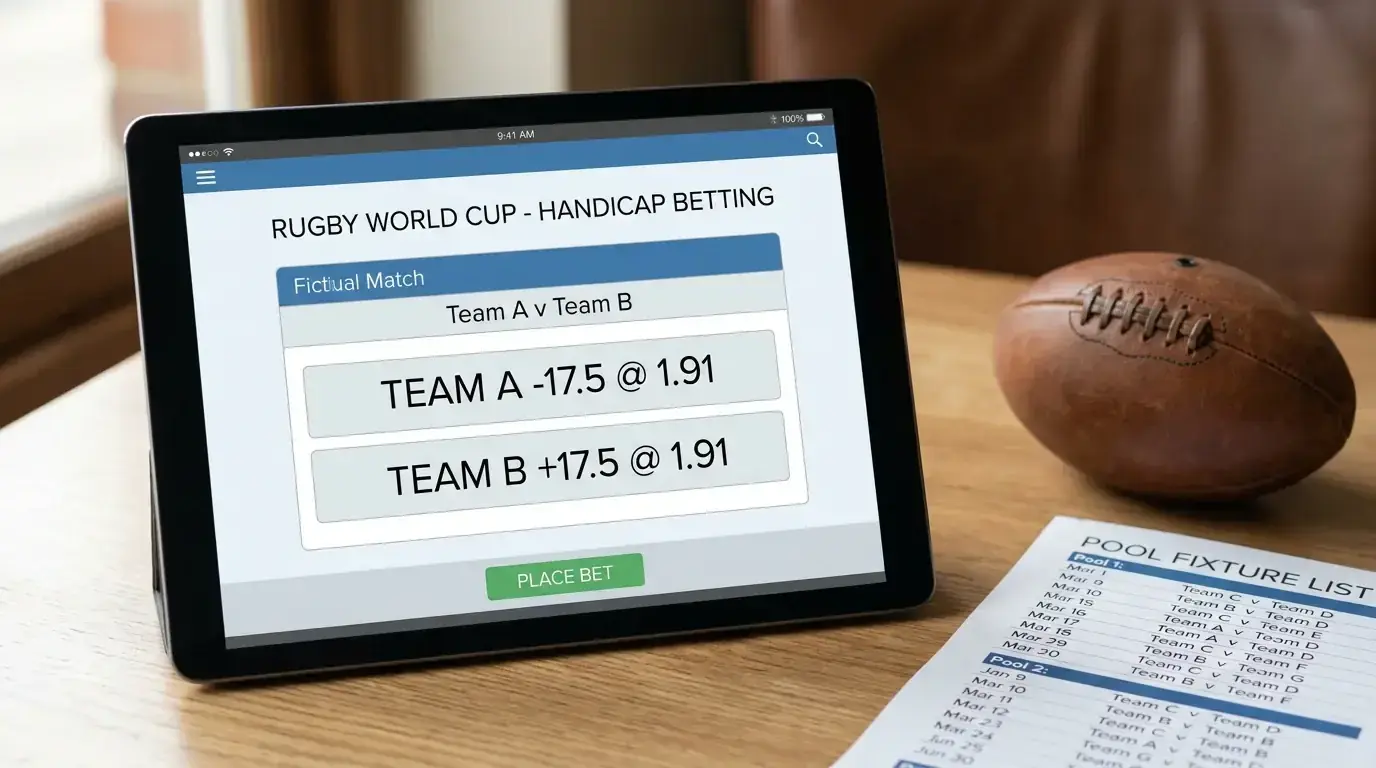
Handicap betting is where rugby starts to feel like its own beast. The bookmaker applies a points start or deficit to one team, levelling out lopsided fixtures. England minus 17.5 against a Tier Two side means England need to win by 18 or more for the bet to land. The price will sit much closer to even money because the handicap has done the work. The expanded 2027 format puts 24 teams into six pools, which means more genuine mismatches and a healthier handicap market. I trade handicaps more than match winners in the pool stage for exactly that reason.
Totals — over/under points — ask you to predict how many points will be scored in the match, both teams combined. The bookmaker sets a line, often around 50 or 55 in big fixtures, and you bet either side. Rugby totals are notoriously bimodal: pool blowouts go well over, tight knockouts go well under. Knowing which kind of game you are pricing is half the battle. Weather, the referee, and team selection all push the total around more than they push the match winner.
Half-time/full-time is the last of the four. You pick the leader at the break and the final winner — both must land. It pays more than a straight match winner because there are nine possible outcomes rather than two or three. Rugby comebacks are rarer than they are in football, which makes HT/FT on a strong favourite a market I look at when the price is right.
Beyond these four sit dozens of niche markets — first try scorer, winning margin bands, race to ten points, both teams to score a try, exact half-time score. They are fun, the prices are big, and the variance is bigger. I dabble. I do not stake heavily.
Tournament-long markets and why they are a different sport
The Rugby World Cup is unusual among sporting events because the tournament-long markets are arguably more interesting than the match-by-match ones. Six weeks of compounding probability creates outright bets you can place months in advance and follow as the price moves. I treat these as a portfolio rather than a series of one-off punts.
The outright winner is the headline market. Back a country to lift the Webb Ellis Cup. Prices on the southern hemisphere giants typically sit between decimal 3.50 and 4.50, France in the second tier, and a long tail of value plays sweeping out to 100/1 and beyond. The decision you have to make on every outright is whether to take the early ante-post price — locking in better odds but accepting weeks of injury risk — or wait closer to the tournament when the line is sharper but shorter. I do both. Early when I am confident in a structural read, late when I want to see warm-up form. There is much more to say on this in my deep dive on how outright Rugby World Cup positions actually work, which covers ante-post mechanics in proper detail.
Pool winner markets are smaller but often better value. A favoured team to top their pool is a cleaner read than the full tournament because you only need to predict three or four results, not seven. The new 24-team format means each pool has four teams playing three pool matches, and the top two go through plus the best four third-placed sides. That structure quietly changes how you should think about pool winner bets — being second is no longer a betting disaster, but it is still worth less than topping the group.

Top try scorer is the most over-bet long market in my experience. It looks irresistible — pick the right wing, watch the tries pile up, collect at the end. In practice it is brutal. A bench player who comes on against weak opposition and stacks four tries can derail months of analysis. The market is so volatile that the early favourite changes hands four or five times across a tournament. Treat it as entertainment.
Player of the tournament is even more subjective. It is essentially a voting market, and votes follow narrative. Players from teams that go deep into the knockouts dominate. Backing a flanker from a side likely to bow out in the quarters is dead money however well he plays. The roughly 290 million monthly online sports bets placed in Britain include a lot of these “feel-good” punts that have very little probability theory underneath. Be the punter who knows this.
Stage of elimination markets — when a specific team will go out — are quietly some of my favourites. They split the tournament into clear chapters, the prices reflect knockout draws cleanly, and the variance is lower than top scorer markets. Worth a look if you want exposure to a country without betting them to win the whole thing.
Building combination bets without losing the plot
Accumulators and bet builders are the two ways British sportsbooks let you stack selections, and they work very differently. Punters confuse them constantly. I want to make sure you do not.
An accumulator combines bets across different matches into one ticket. Pick the winner of England versus France and the winner of New Zealand versus Ireland, link them together, and your stake rides on both. The odds multiply, the return rockets, and a single losing leg means the whole acca falls. Five legs at decimal 1.80 each pays roughly 18 to 1. Six legs takes you to 34 to 1. The maths is seductive. The fact that you need every single leg to win is not.
I once ran the numbers on a six-leg acca of “obvious” pool stage favourites — six matches where the average win probability was a comfortable 85 per cent. The compound probability of all six landing was 0.85 to the power of six, which is 37.7 per cent. Less than two times in five. The bookmaker, by definition, is pricing that acca with a margin that makes it a losing bet over time. The fun is real. The expected value is not.
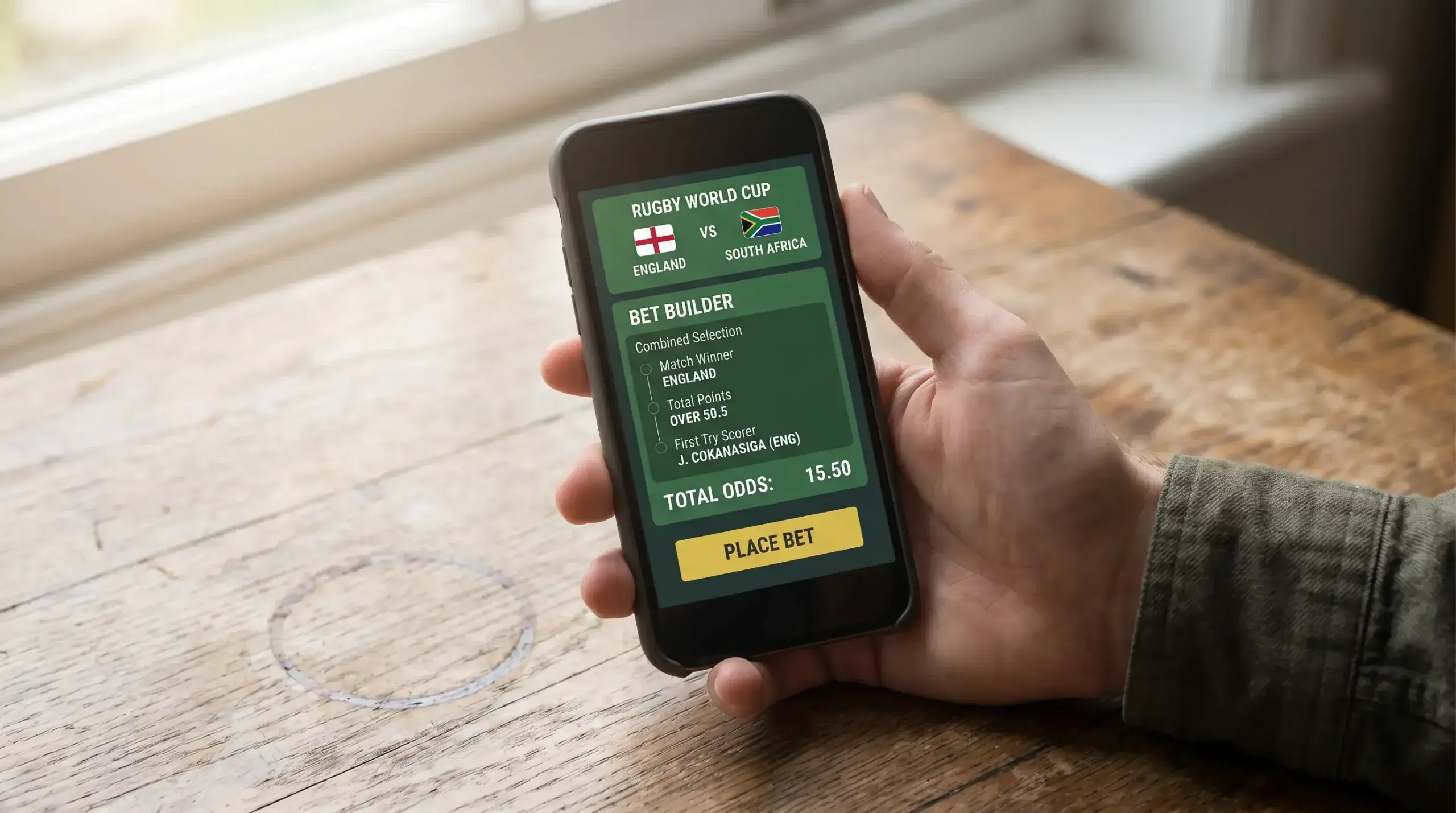
A bet builder, by contrast, combines selections within a single match. Same fixture, multiple outcomes: England to win, over 50.5 total points, a specific player to score a try, more than 12 penalties kicked. The book calculates correlation — some of these outcomes are linked, so they do not multiply the way independent legs would — and prices the combined ticket accordingly. Bet builders feel clever because they pay big on small stakes, but the margin on combined-market tickets is significantly higher than on single-market bets. The bookmaker’s cut grows with every selection you add.
My rule on combination bets is simple: I will build a small-stakes acca for entertainment on a tournament weekend, but I do not consider it serious betting. Real money goes on single-selection bets where I have a defensible edge. If you do build accas, build short ones — three legs at most — and stake them as if the money were already lost. Tournament-long discipline depends on protecting yourself from the days when the multi-leg dream falls apart in the last sixty seconds of the final game.
One more piece of practical advice: cash out exists on most UK sportsbook apps for both accas and bet builders. The price the book offers to settle your ticket early is always worse than the implied probability of you winning from where you stand. Cash out is convenient. It is also expensive. Use it when you genuinely want to reduce exposure, not just to feel the warm rush of locking something in.
The beginner mistakes I see every single tournament
Andrew Rhodes, the chief executive of the Gambling Commission, put it cleanly when he encouraged operators to use the regulator’s own evidence base. The line that stuck with me was that “this year’s findings deepen our understanding of consequences from gambling and provide crucial insight into risk profiles among those who gamble most frequently.” Translated to the betting floor, the people who get into trouble are almost always the ones doing the same identifiable things over and over. None of these mistakes are exotic. All of them are fixable.
The first is staking by emotion. A favourite team you love is exactly the team you should not bet on without extra scepticism, because your private probability is biased upward. I have a rule: if I want to back England, I write out my arguments for backing them and then I write out the equivalent arguments for backing France in the same fixture. If I cannot defend either equally, I am supporting, not analysing.
The second is chasing losses. A bad bet on Saturday creates an emotional debt that wants to be paid by Sunday. The danger is staking up to recover, or taking on a market you do not understand because the price looks bigger. Set a session limit. When you hit it, you are done for the day. The tournament runs for six weeks. There is always tomorrow.
The third is misreading the price. New punters often see decimal 2.00 and think “even money, fifty-fifty” — but 2.00 after the bookmaker’s margin actually implies somewhere around 47 to 48 per cent. The price is rarely as fair as it looks. Always convert to implied probability before deciding whether a bet is value.

The fourth is ignoring weather and venue. Rugby is a sport played outdoors, often in November in the southern hemisphere, sometimes in tropical Queensland. A wet pitch can shave 15 points off a total and turn a free-running favourite into a grinding kicker. Weather forecasts are part of the analysis, not a footnote.

The fifth is shopping for the worst price by accident. Loyalty to one sportsbook costs you implied probability points across every bet. Use comparison sites. Hold accounts at three or four UK-licensed brands so you can always take the best available number on a market you want to play.
And the sixth, the one I see most often: betting on every match. A Rugby World Cup has roughly 50 fixtures across six weeks. Nobody, including me, has a real edge on all of them. Bet the ones you have actually studied. Watch the others.
If I could add a seventh, it would be ignoring the fixture list. Pool draws are not random in their consequences. A team in the toughest pool faces a brutal route through the knockouts even if they qualify, and that compounding difficulty rarely shows up cleanly in match-by-match prices. Read the bracket before you take any tournament-length position. The team that looks well-priced in isolation often looks very different once you trace the path they have to walk.
And finally, a softer point that matters more than the others combined: betting should not stop being fun. The moment you find yourself dreading match results, hiding losses, or staking money you needed for something else, the relationship has gone wrong. UK-licensed sportsbooks all carry the tools to step away such as deposit limits, time-outs and full self-exclusion through GamStop. Use them before you need them, not after.
