


The seductive maths of multiplying odds
Every Rugby World Cup, someone in my circle of mates sends me a six-leg accumulator from the opening weekend and asks me to “sanity check” it. The combined price is always eye-watering. Stake a tenner, return three or four hundred. The first time I saw one, I was hooked. Then I started running the maths backwards, and the seduction wore off in a hurry.
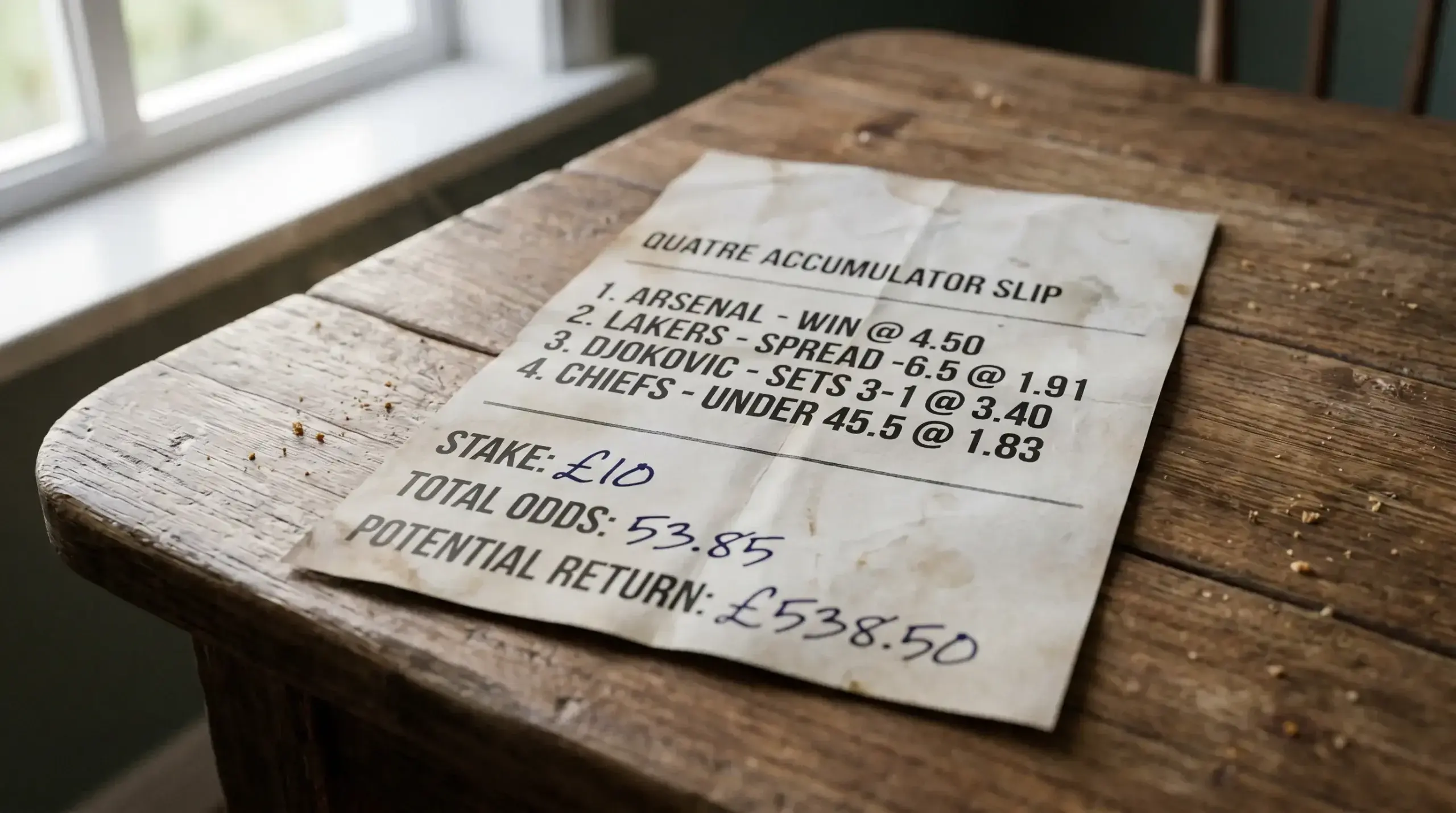
An accumulator — an “acca” to anyone who has ever placed one — is a single bet where multiple selections are combined into one slip. Every leg must win for the bet to pay out. The price is the product of all the individual prices, which is why the returns look so juicy. The catch is that the probability of cashing the slip is also the product of all the individual probabilities, which collapses fast.
The acca is one of the most popular structures on UK rugby betting precisely because it offers the dream that a single, sensible-looking £10 stake can return a life-changing payout. Some 76% of UK bettors aged 18–24 place their bets on mobile, and the acca is the format the in-app builder steers people towards. Roughly 290 million online bets land in the UK every month, and a meaningful share of those are accas. The volume tells you something. So does the bookmaker’s margin baked into each leg, which compounds the same way the price does.
How accas combine odds
The mechanic is straightforward arithmetic. If you back four selections at decimal prices of 1.50, 1.80, 2.00, and 2.50, the combined price is 1.50 × 1.80 × 2.00 × 2.50 = 13.50. A £10 stake returns £135 if all four legs win. Lose any leg, and the slip is dead. There is no partial settlement, no consolation payout, no “three out of four” rebate.

That multiplication is the seductive bit. Now look at the implied probability. If each leg is genuinely a 60% shot (the rough fair value of a 1.67 price before margin), the combined probability is 0.60 × 0.60 × 0.60 × 0.60 = roughly 13%. The slip pays at 13.50 but only cashes 13% of the time. Even at fair odds, four short-priced legs is a long-shot bet dressed up as a high-probability one.
The margin problem makes it worse. Every leg you add includes a bookmaker overround of roughly five to seven percent. Four legs compounds that into a 20-30% built-in disadvantage before a single ball is kicked. The slip looks generous because the headline price is high, but the price-to-probability ratio is worse than any single selection on the slip.
UK books usually allow accas from two legs upward, with the cap varying by operator — typically 20 to 30 legs at most. The minimum stake is normally £0.10 or £0.20. The maximum payout is capped, often at £100,000 or £250,000, which most casual punters never read until they hit it. Always check the slip cap on long-shot accas. I have heard of people watching their imagined seven-figure payout settle at a quarter of that because the cap kicked in.
The risk trade-off nobody talks about
The fundamental property of an accumulator is that risk does not increase linearly with the number of legs. It compounds. A two-leg slip at 60% per leg has a 36% chance of cashing. A four-leg version of the same selections has a 13% chance. An eight-leg version has under 2%. The payout grows in proportion to the bookmaker’s stated price; the probability of cashing collapses much faster.

This is what makes the acca the bookmaker’s favourite product. The expected loss per pound staked on a typical six-leg acca is significantly worse than on a single selection at the same combined price elsewhere on the menu. The acca format encourages punters to keep adding legs they would never bet on individually — a -22.5 handicap they are not sure about, a both-teams-to-score-a-try slot in a one-sided pool fixture — because each addition juices the combined price.
I run the same test on every acca that crosses my desk: would I stake the equivalent flat-stake amount on each leg as a single bet? If the answer is no for even one leg, that leg is being carried by the others, and the slip’s expected value is worse than the sum of its parts. The legs you would not bet individually are usually the ones that kill the slip.
There is also a psychological cost worth naming. A six-leg acca that loses on the final leg is one of the most demoralising experiences in betting. Five hours of going well, one moment of going badly, slip in the bin. People chase that loss harder than any other category I have seen. If you are going to play accas, accept the variance going in, or do not place them at all.
Acca insurance and bonuses
UK books know exactly how painful a single-leg bust is, and most of them now offer some version of acca insurance: a refund — usually in free bet form — if one leg of a qualifying acca lets you down. The headline reads well. The terms read less well, and they matter more than the headline.

Typical conditions include a minimum number of legs (often four or five), a minimum combined price (often 5.00 or higher), and a maximum refund amount (often capped at £10 or £25). The refund itself is almost always credited as a free bet rather than cash, and the free bet usually requires a further qualifying stake before any winnings on it can be withdrawn. Read the small print before you stake. The same Gambling Commission line — that operators should use available evidence on consumer behaviour — applies just as much to how acca insurance is presented as it does to any other promotional structure.
Acca boosts are the other common offering. The book inflates the combined price by an advertised percentage — five percent extra at three legs, ten percent at five, twenty percent at eight — if the slip wins. The boost is genuine money, and it is a meaningful sweetener on slips you were going to place anyway. It is not a reason to add legs you do not believe in. The marginal increase in price from a boost rarely outweighs the marginal decrease in probability from a weak leg.
My own framework on insurance and boosts: I take them when they apply to a slip I would have placed anyway, and I ignore them when they are advertised as “stake a £25 acca, get £5 free bet”. The free bet is roughly worth a third of its face value once you account for the requirements to clear it, and that is rarely enough to change the maths on a slip that was marginal to begin with.
If you are putting selections from one fixture into a single slip rather than across several matches, that is a different product — a single-fixture build. The market structure works differently, and the bet builder market is the right read for those slips.
How to actually use accas without losing your shirt
Accas are not unwinnable. They are just structurally biased against the punter, which means the only way to play them sensibly is to treat them as an entertainment product with a small stake, not as a route to outsized profit. The discipline that follows from that framing tends to keep slips at three or four legs, not seven or eight.

The pattern I have settled on, after years of being burned, is to limit accas to legs I would individually back at a flat stake. If a slip has four legs and I would happily stake a unit on each of them as singles, the acca version is a legitimate sweetener — same selections, lower probability of cashing, higher upside. If even one leg is “filler” added to boost the price, I cut it. The slip almost always plays better with three legs you believe in than four where one is questionable.
Stake sizing is the other half. An acca should be a small fraction of the unit size you use for singles. Two to five percent of bankroll per slip, not the same flat stake you would put on a single bet. The variance demands it. A slip that cashes only one time in eight needs to be sized as such, or the cash slips fund nothing and the losing slips eat the bankroll.
