


Two ways of writing the same number
I once asked a friend who had been betting for thirty years which format he preferred. He looked at me as if I had asked whether he preferred Tuesdays or the colour blue. To him, the question was meaningless — the formats describe the same thing, the same way that one mile and 1.6 kilometres describe the same distance. The difference is convention, not maths.
That answer is technically correct, but it papers over something real. The format you read changes what jumps out at you. Fractional odds make the profit obvious. Decimal odds make the return obvious. The profit and the return are different numbers, and which one you instinctively process first shapes how you think about every bet you place. Around 13.5 million online accounts are active in the UK each month, and most of them flick between the two formats without noticing what the switch is actually doing to their reading of the slip.
This article is for the punters who have always been mildly unsure which format is more useful, and for everyone who clicks the format toggle in their app’s settings without quite knowing what they are getting in return.
Reading fractional odds
Fractional is the format the British high-street bookmaker has used for a century. A price of 5/1 — read “five to one” — means that for every £1 staked, the bet returns £5 in profit if it wins. The £1 stake is also returned, so the total payout on a winning £1 bet is £6. Same logic at any stake size: a £10 bet at 5/1 returns £50 profit plus the £10 stake, total £60.

The format is built around the profit-to-stake ratio. The number on the left is profit, the number on the right is stake. 5/1 reads “win five for every one staked”. 1/4 reads “win one for every four staked” — these short prices are common on heavy favourites where the punter is risking a lot for a little. A favourite at 1/4 returns 25 pence profit on a £1 stake, plus the £1 back, total £1.25.
Fractional odds where both sides of the ratio are larger than 1 sometimes appear — 9/4, 11/8, 6/4. These are real prices, just expressed in their original form rather than reduced. 9/4 means £9 profit for every £4 staked. Stake £4, win £9, total return £13. Some books simplify these to their decimal equivalent in the slip preview, but the headline price keeps the fractional shape.
Evens — written EVS in some books, 1/1 in others — is the price at which profit equals stake. £1 returns £1 plus the £1 back, total £2. It is the boundary between “odds-on” prices (favourites) and “odds-against” prices (underdogs). Anyone who has spent five minutes on a UK betting site has seen “EVS” in big letters somewhere.
The format is excellent for one specific question: how much do I win? It is less useful for the question of what return I get. The £1 stake plus £5 profit sequence is just the kind of mental arithmetic that gets harder at unusual prices — 17/4, 13/8, 23/10. The brain adds the implicit £4, £8, £10 stake to the profit and gets the total return, but the operation is not free.
Reading decimal odds
Decimal is the format used across most of Europe, Australia, and increasingly on UK exchange platforms. A price of 6.00 means that a £1 stake returns £6 in total if the bet wins. That total includes both the profit and the original stake. Stake £10 at 6.00, total return £60 — of which £50 is profit and £10 is the original stake coming back.
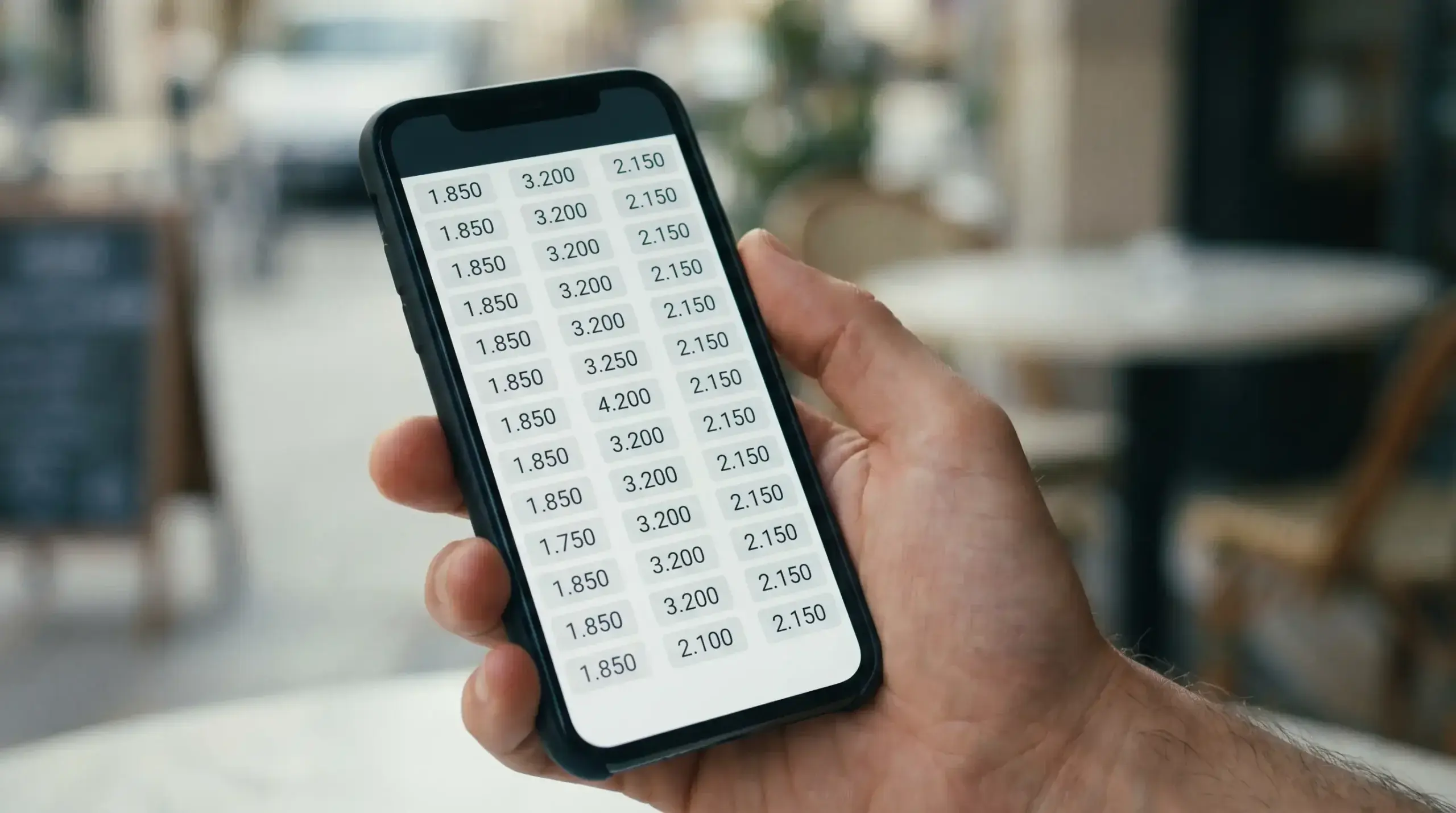
The format is built around the total return per stake. Multiply your stake by the decimal number, and you have your total payout in one operation. No splitting profit from stake. No mental arithmetic. The number on the screen is the multiplier for the return.
This format is easier for one specific class of questions: anything that involves calculating returns or comparing prices. Stake £20 at 2.50 — total return £50. Stake £20 at 2.50 versus stake £20 at 2.40 — the first returns £50, the second returns £48. Two pounds difference. The same comparison in fractional reads “3/2 versus 7/5”, and your brain does extra work to confirm that 3/2 is the better price.
Evens in decimal is 2.00. Anything below 2.00 is odds-on, anything above is odds-against. Decimal also handles very short prices more cleanly than fractional. A favourite at 1.10 reads instantly as “10% extra on a winning slip”. The fractional equivalent is 1/10 — also fine, but slightly less intuitive at a glance.
The 2025 women’s Rugby World Cup attracted 444,465 ticket sales across 32 fixtures with 92% of available tickets snapped up, and the bookmaker traffic on those matches mostly defaulted to decimal in the betting apps used by younger punters. The format is becoming the standard for mobile in the UK, even though fractional remains the format on the headline boards in physical shops.
Converting between the two formats
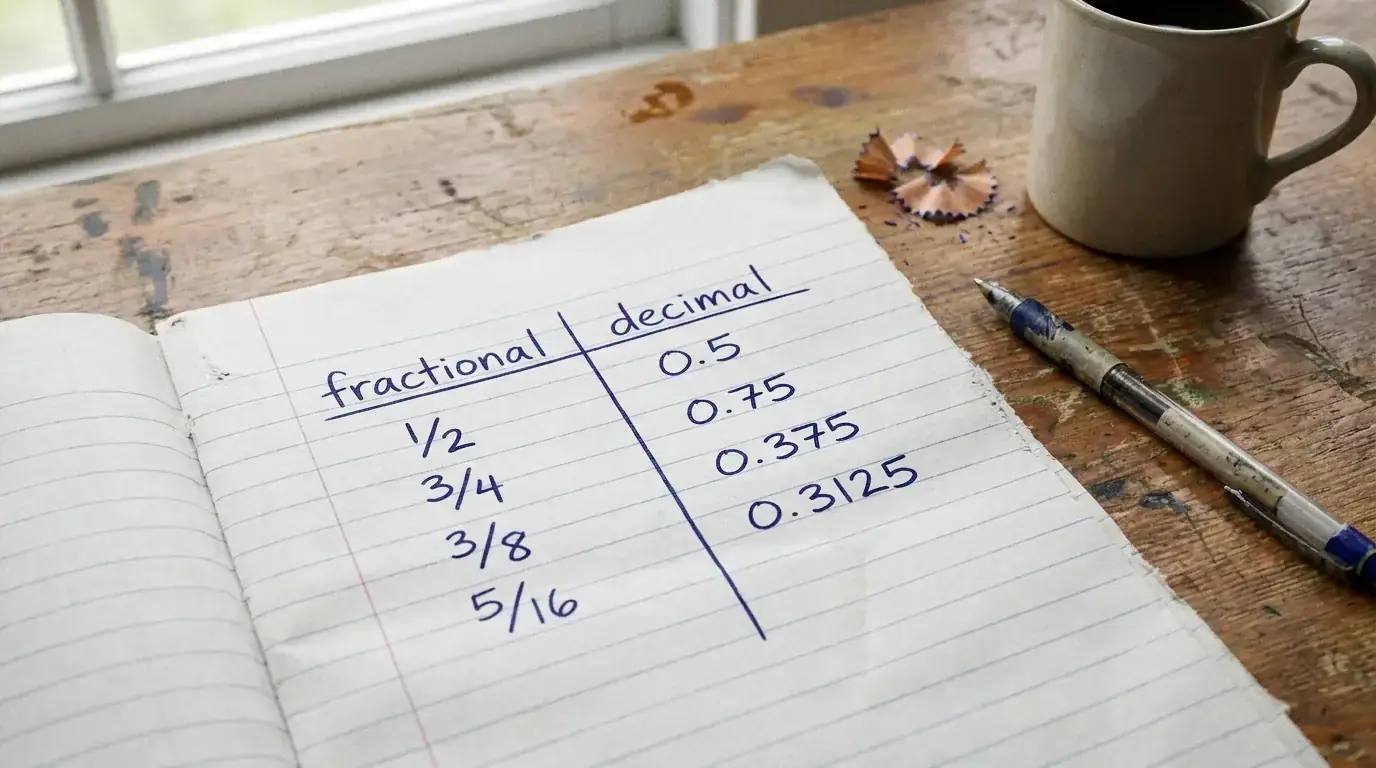
Conversion is a one-step exercise once you remember the rule. Fractional to decimal: take the fraction, divide left by right, add one. 5/1 becomes 5 + 1 = 6.00. 7/2 becomes 3.5 + 1 = 4.50. 9/4 becomes 2.25 + 1 = 3.25. The “plus one” accounts for the returned stake that decimal includes and fractional does not.
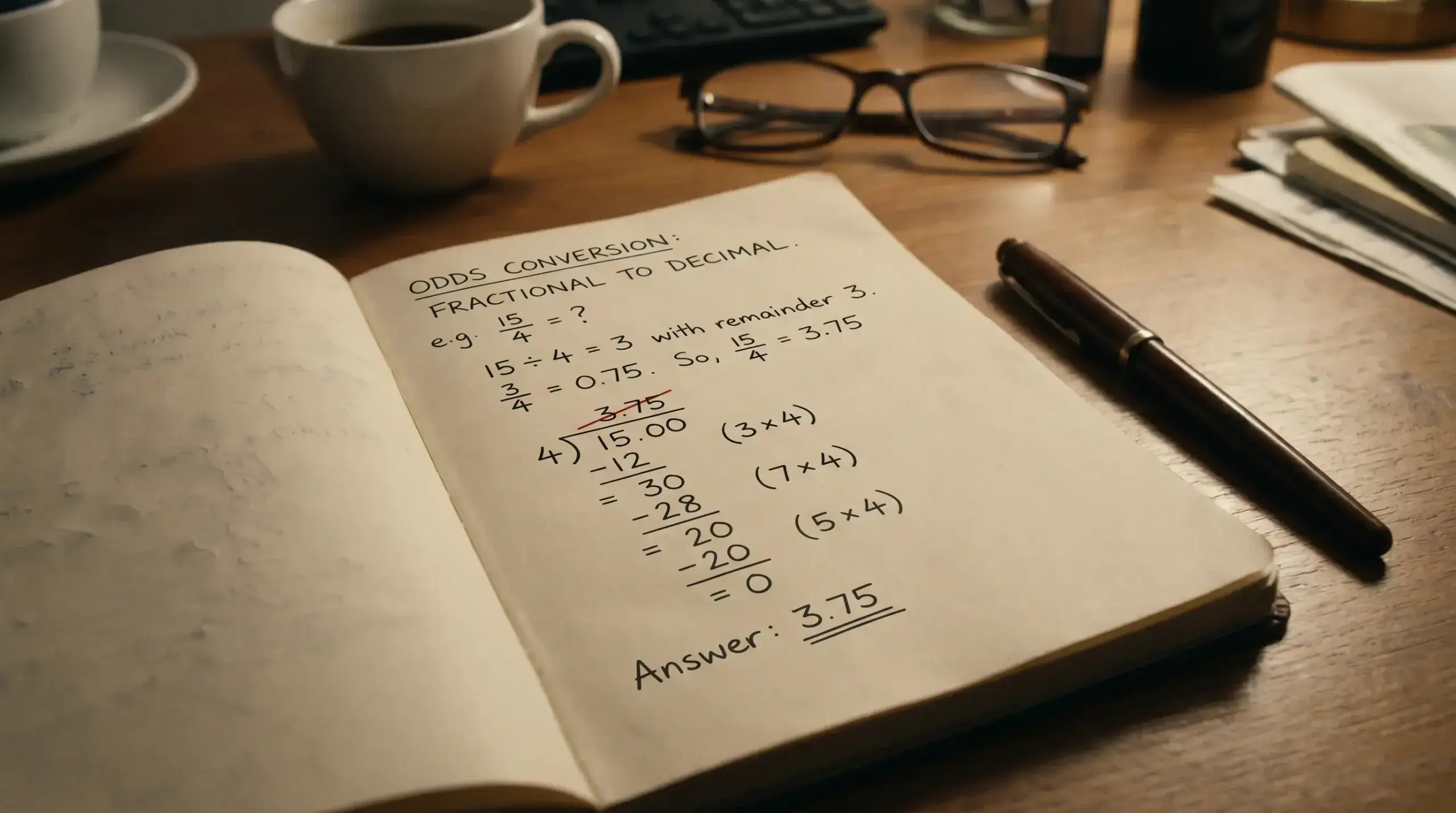
Decimal to fractional: subtract one, then express the result as a fraction. 6.00 becomes 5/1. 4.50 becomes 7/2 (because 3.50 = 7/2). 3.25 becomes 9/4. The reduction to the simplest fraction is sometimes manual, but most books display both formats side by side when you toggle.
For practical purposes, you only need to be able to do this conversion in one direction reliably. Pick whichever direction matches the format you do not normally use, and learn it cold. Both formats are mathematically identical, and the moment you can switch between them at a glance is the moment you stop caring which one your app defaults to.
A useful mental shortcut for British punters who prefer fractional: any decimal price between 1.50 and 3.00 has a fractional equivalent that is a common British convention. 1.50 = 1/2, 1.80 = 4/5, 2.00 = EVS, 2.50 = 6/4, 3.00 = 2/1. Memorise this small set of equivalents and most price comparisons become automatic. The same shortcut works in reverse for punters who prefer decimal.
If you want to think about how these prices actually reflect probability, the value betting market is the natural read alongside this one. Format mastery is the basic literacy; spotting value is the next-level skill that builds on top of it.
Which format actually helps you bet better
Neither format gives you a mathematical advantage. The same price expressed in fractional and decimal pays the same money. But the format you read changes which questions feel natural to ask about a slip, and that subtle effect compounds over a year of betting.

Fractional encourages you to think about profit. “I stand to win £150” is the kind of mental framing that comes naturally when looking at 15/1 on a tenner. The framing is useful for getting a clear picture of what a slip pays. It is less useful when comparing prices, because the comparison requires extra mental arithmetic.
Decimal encourages you to think about expected value. “This price implies a 25% probability” is the kind of mental framing that comes naturally when looking at 4.00 on a slip. The framing is useful for assessing whether the bet is value relative to your own estimate of the underlying probability. It is less useful for understanding the cash payout, because the cash payout requires you to subtract the stake from the return.
My own habit is to keep both formats visible on every slip I look at. Most UK books offer this option in settings. The fractional format is my default for displaying the headline price — old habits from the high street — but the decimal version sits next to it for the moments when I want to compare prices across operators or convert quickly to implied probability. The combination removes the cost of either format’s blind spots.
What experienced punters do that beginners do not
The single behaviour that separates experienced bettors from beginners on this question is converting price to probability without thinking. A price of 4.00 is a 25% implied probability — 1 divided by 4.00, multiplied by 100. A fractional 3/1 is also 25%. Reading the price in either format and instantly knowing what the bookmaker is saying about the underlying probability is the foundation of every later judgment about whether the slip is worth taking.

Conversion from fractional to probability is slightly clunkier. 5/1 means stake equals one-sixth of total return, so the implied probability is 1/6, or roughly 16.7%. The denominator is the sum of the two numbers in the ratio, not just the right-hand one. Beginners often misread 5/1 as a 20% chance because they divide by the right-hand 1 alone. The error compounds across slips and shapes which bets feel like value when they are not.
Whichever format you settle on, the probability layer underneath the prices is where actual betting analysis happens. The format is a window into that probability. Pick whichever window you find easier to read through, and ignore the rest of the format debate as the matter of taste it actually is.
